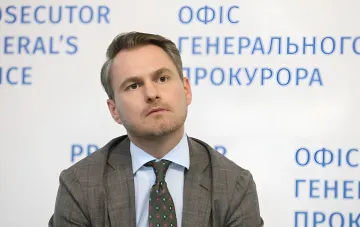
On August 19, 2026, Irina Mudra was dismissed from her position as Deputy Head of the Office of the President of Ukraine and received a suspicion from the National Anti-Corruption Bureau (NABU) and the Special Anti-Corruption Prosecutor's Office (SAP). On August 25, 2026, the High Anti-Corruption Court (VAKS) selected a preventive measure for her — 60 days in custody with the alternative of posting a bail of 20 million UAH, while the prosecution had requested 150 million UAH. The high-profile case, known in the media as the "Forrest Gump" case, has gone beyond standard corruption reporting: the focus is not only on the official's declared assets, but also on the family asset perimeter — her daughter, mother, and common-law husband, whose financial trails, according to the investigation, lead into the shadow construction sector and foreign jurisdictions.
Procedural Status and Separation of Versions
The key to correctly understanding this material is the strict separation of three planes of facts. The first — officially declared assets in the NAC's electronic declarations: real estate in Kyiv (apartments, parking spaces), expensive watches, jewelry, cars, and official savings in accounts and in cash. The second — the claims of SAP prosecutors, read in court on August 24–25, 2026: according to their version, the actual volume of assets under the suspect's control exceeds 250 million UAH, and the materials of covert investigative actions (wiretaps of conversations with the former MP and developer Maksym Mykytas) mention undeclared sums, including the transfer of "Ukrbud" assets worth 4 million dollars and monthly top-ups of around 20,000 dollars. The third — the position of Mudra herself and her defense, who categorically reject the charges, stating that the 4 million dollars were never received, and that the conversation recordings, in their view, were taken out of context or fabricated. Until a verdict is delivered, the presumption of innocence applies, and all the figures cited by the investigation should be perceived as the prosecution's version, not as a fact established by the court.
The Family Perimeter: Daughter Karina Shatrova and the "American Dream"
According to data set out in the analytical dossier and confirmed, as the investigation claims, by operational materials, Mudra's 25-year-old daughter Karina Shatrova (born 2001) in her teenage years attended the Israeli integration program "Naale" at one of the prestigious boarding schools and obtained Israeli citizenship; however, according to available information, she did not serve in the IDF, returning to Kyiv, where she studied at a university for about a year. In 2020–2021 she moved to the US and, according to the dossier, settled in Florida (Miami), displaying an affluent lifestyle on social media — travel, yachts, plastic surgery, a luxury wardrobe. In her name, according to the same materials, an elite Lexus RX crossover and a 138 m² country estate in the village of Bohdanivka near Kyiv are registered. On NABU footage read by the SAP prosecutor at VAKS, a direct conversation between Mykytas and Shatrova is recorded, in which he, as the prosecution claims, takes on the sponsorship of her upkeep in the US with a budget of 120,000 to 250,000 dollars per year.
The Mother and the Israeli Asset Track
The 73-year-old mother of the suspect, Lyudmyla Mudra, according to available information, lives in Rishon LeZion, Israel, and holds Israeli citizenship. In her name, according to the dossier, accounts at the Israeli bank Bank Leumi are registered with balances in the hundreds of thousands of shekels/dollars, as well as a 70-square-meter apartment in the elite premium-class Park Avenue VIP residential complex in Kyiv, which, according to the materials, was allegedly "gifted" to the elderly woman. The geography of the family assets — Israel (the mother's and daughter's citizenship and accounts), the US (the daughter's education and life, the birth of Mudra's younger son in the US, which grants American citizenship by jus soli, and investment stock packages), and Ukraine, which, according to the analytical assessment, serves primarily as a source of cash generation. These data, however, require verification within the investigation and are not, at this time, facts established by the court.
Real Estate in the "Aristocrat" Complex and the Price Anomaly
Particular resonance was caused by the story of the real estate purchase by Mudra's common-law husband, the senior National Bank official Pavlo Polyarush. In May 2018, according to his declaration, he became the owner of a 90-square-meter apartment in the prestigious "Aristocrat" residential complex on Pechersk for 791,400 UAH — about 30,000 dollars at the exchange rate of the time, i.e. roughly 8,700 UAH per square meter. For comparison: Irina Mudra herself, a few months later, purchased a 55.7 m² apartment in the same complex but declared it at the market price of 2.1 million UAH. Thus, the square meter for Polyarush, by the arithmetic of the declarations, turned out to be several times cheaper than the market. The "Aristocrat" complex, built by "Ukrbud," is simultaneously a key piece of physical evidence in a separate anti-corruption case against the former leadership of the National Guard, where, according to the investigation, apartments for military personnel were stolen and replaced with housing on the outskirts of Kyiv, causing damage to the state of over 100 million UAH. The totality of these circumstances — a "for insiders" discount against the backdrop of the failed housing for military personnel — forms the basis for questions about the presence of a conflict of interest and undue benefit, which the investigation and the court must resolve.
Contradictory Data
In the case materials and the statements of the parties there are significant inconsistencies that must be openly laid out. First, the discrepancy between the officially declared assets in the NAC and the SAP prosecutors' assessment of over 250 million UAH: the prosecution claims the existence of undeclared sums and assets, while the defense insists that the actual volume of property matches the declarations. Second, the question of the 4 million dollars from "Ukrbud": according to the investigation, these funds were transferred; according to the defense, they did not exist, and the conversation recordings were taken out of context or fabricated by a close person in personal interests. Third, the dispute over the wiretaps: the prosecution relies on the footage read in court, while the defense disputes their authenticity and context. Fourth, the data on the daughter's citizenship and military service, as well as on the mother's foreign residence and accounts, are based on the analytical dossier and open registries, but have not been confirmed by a court decision and may be contested. Until a verdict is delivered, all the aforementioned contradictions remain a matter of proof, not established facts.
Analytical Conclusion
The case of Irina Mudra has become, in the editorial assessment, a mirror of the double morality of part of the ruling elite: in the public sphere, narratives of defending sovereignty and fighting for reparations are broadcast, while in the non-public sphere — according to the investigation — the families of top officials build "backup airstrips" in other jurisdictions, and their way of life, as the prosecution claims, is financed by toxic business structures. The VAKS decision of August 25, 2026, on detention with the alternative of a 20 million UAH bail is only a procedural milestone, not a verdict. The final assessment of guilt or innocence, as well as the actual volume of assets, will be established exclusively by the court on the basis of evidence presented by both sides. Until that moment, all the investigation's figures remain the prosecution's version, and the suspect herself is innocent in accordance with Article 62 of the Constitution of Ukraine.