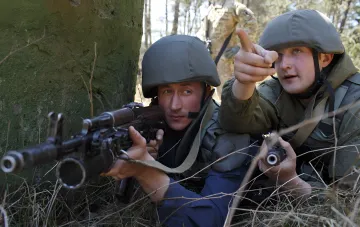
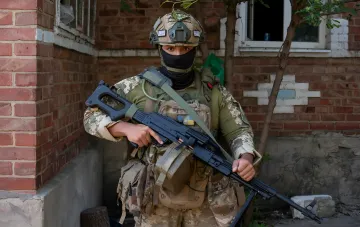
According to the Institute for the Study of War (ISW), on August 26 and 27, 2026, the Russian Armed Forces launched offensive operations on several sections of the front, but in the overwhelming majority of cases their plans were thwarted by counterattacks from the Ukrainian Defense Forces. This is reported by RBC-Ukraine, citing the latest ISW analytical report. Ukrainian forces not only halted the enemy's advance but also launched their own offensives in several areas, expanding their control over border territories.
Kharkiv and Kupyansk directions: offensive stalled
In the north of Kharkiv Oblast, Russian troops continued offensive operations on August 26–27, but failed to hold their new positions. According to a Russian military blogger, on August 27 the Ukrainian Defense Forces launched a counterattack near the settlements of Izbitske and Starytsia, completely blocking the enemy's advance. A similar picture was observed on the Kupyansk direction: the occupiers had been attempting to advance over the previous two days but faced stubborn resistance from Ukrainian forces. In particular, Ukrainian counterattacks were recorded in the area of Dvorichna, which prevented Russian forces from achieving their tactical objectives.
Borova direction: Ukrainian forces advanced and captured strongpoints
The most significant territorial changes were recorded in the Borova area. According to a source linked to the Russian Western Group of Forces, on August 27 Ukrainian troops advanced to the southeast of Borova. During the counterattack they captured several strongpoints and expanded their control over the so-called "grey zone" near Redkodub, Katerynivka, and Nove. ISW had previously recorded geolocation evidence of the advance of Ukrainian forces in this area and, accordingly, revised its assessment of the front line, confirming the stability and consistency of the Ukrainian offensive momentum in this sector.
Slaviansk, Drobovytsia, and Pokrovsk directions: no confirmed Russian successes
On the Slaviansk direction, Russian troops continued offensive actions on August 26–27, but ISW recorded no confirmed advance. Ukrainian forces, in turn, counterattacked near Lyman and, according to reports, expanded their control in the "grey zone." Russian offensive operations in the Drobovytsia tactical area and on the Pokrovsk direction also ended without results — Russian troops failed to advance. Near Novepavlivka, as well as to the northeast and south of Oleksandrivka, the enemy carried out only limited attacks that did not lead to confirmed territorial gains.
Contradictory data
At the same time, not all sources paint an exclusively negative picture for Russia. According to the ISW report, distributed by Ukrainian media outlets (including 24tv.ua), Russian troops did manage to record a local advance in the Huliaipole area. This creates a certain contrast with the overall assessment, according to which Russian offensive operations on most directions were thwarted. Thus, the picture of the front remains uneven: on some sections Ukrainian forces are confidently counterattacking and advancing, while on others Russian forces retain limited initiative. The differences in assessments may be linked to the fact that some data comes from Russian military bloggers and sources linked to the groups of forces, whose objectivity is questioned.
Context: breakthrough in three oblasts and new drones
Earlier, RBC-Ukraine reported that the Defense Forces broke through in three oblasts at once, indicating a systemic character of the counteroffensive actions rather than isolated episodes. Against the backdrop of these events, Russia announced the day before an attack on Ukraine using new "Geran" drones, indicating Moscow's attempt to compensate for tactical failures on the ground by employing air-strike means. The totality of the data indicates that at the current stage of the conflict, the initiative at the tactical level has largely shifted to Ukrainian forces, who are actively using counterattacks to stabilize and improve their position on the front.