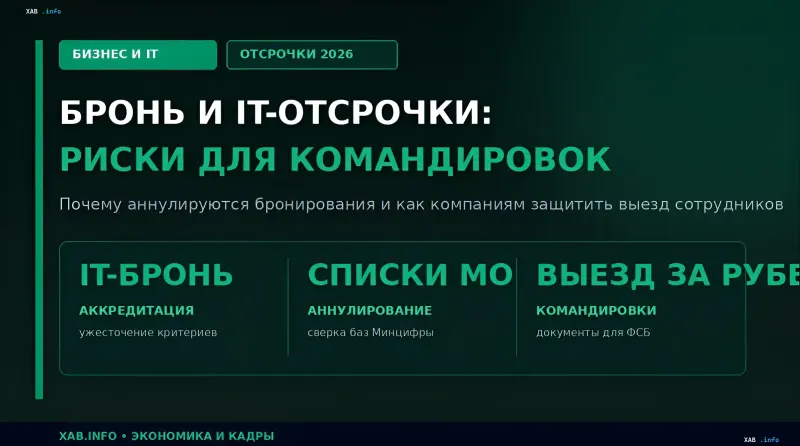
For the corporate sector, the tightening of border controls in 2026 has become a structural risk factor when planning foreign business trips. The key analytical thesis is that the formal presence of an IT deferment or enterprise reserve status is no longer a sufficient condition for crossing the border without hindrance: the decisive factor becomes passing full interdepartmental data verification. In macroeconomic terms, this means an increase in operational costs for personnel logistics, lengthening of approval cycles for trips, and the need to establish internal corporate procedures for controlling the currency of registers. For companies whose business model relies on international projects and service maintenance, such changes directly affect contract execution timelines and reputational risks before foreign clients.
Mechanics of Interdepartmental Verification and Delays in Register Uploads
The central node of risk is the data transfer chain: lists of accredited IT companies are formed and transmitted to the Ministry of Digital Development (MinTsifry), then sent to the General Staff, and only afterwards are uploaded to the databases of the Border Service of the FSB. Any link in this chain can become a point of failure. If an employee changes employers or the company submits lists late, the mark about the deferment in the FSB database may simply be absent, which in practice leads to delays or refusal of exit at the checkpoint. From a legal point of view, this creates a zone of legal uncertainty: the formal right to deferment exists, but it is technically not confirmed in the system used by the border guard. For business, this means the need to monitor the terms of register uploads and reserve time for re-submitting data.
Tightening of Accreditation Requirements and Automatic Cancellation of Reserve Status
The second systemic factor is the raising of the accreditation threshold. Companies that fail to confirm the share of relevant revenue or compliance with average wage criteria lose their status as an accredited organization, which leads to the automatic cancellation of reserve status for the entire staff. From the point of view of long-term planning, this turns accreditation from a one-off administrative action into a continuous compliance process: financial and HR departments have to quarterly check revenue by activity codes and median wage indicators. An error in the reporting of one company can instantly deprive dozens of specialists of deferment, which is critical for projects with fixed deadlines and international obligations.
Summons for Medical Examination and Travel Blockade
The third, often underestimated risk is related to procedural obligations. The presence of an IT deferment does not exempt the employee from the obligation to appear upon summons for clarification of account data and undergoing medical examination. Non-compliance with this requirement activates a travel blockade regardless of the employer's accreditation status. For the corporate sector, this means that even an impeccably prepared document package does not relieve the employee of individual procedural responsibility. Lawyers recommend including in corporate business travel regulations a check of the currency of account data in the military commissariat a certain period before departure to exclude the triggering of a blockade at the time of control.
Corporate Document Package for Traveling Specialists
A practical response to the described risks is an expanded document package that lawyers recommend forming for each traveling specialist. It includes: a certified copy of the employment contract and a certificate from the place of work indicating position and seniority; an extract from the register of accredited IT organizations or enterprises of the defense industry and system-forming companies; a copy of the diploma in a relevant higher education from the list of specialties of MinTsifry; an official order on assignment to a foreign business trip indicating dates and route; as well as a certificate from the military commissariat on the absence of mobilization restrictions, if available. Such a package does not cancel interdepartmental verification, but significantly increases the chances of an operational resolution of disputed situations at the border and records the good faith position of the employer.
Contradictory Data
During fact-checking, a significant jurisdictional discrepancy was revealed. The main analytical material describes Russian regulatory and administrative practice: it speaks of MinTsifry, the General Staff, the Border Service of the FSB, and the Russian order of accreditation of IT companies. At the same time, the attracted verification sources (unian.net, svpressa.ru) record a related but different context — Ukrainian legislation on reserve status from mobilization, which came into force on March 1, 2026, and discussions about possible bans on leaving the country for men with reserve status. Thus, the general principles — that reserve status does not guarantee automatic exit and that tightening of border controls affects borrowed and business trips — are confirmed in both contexts, however, direct digital and regulatory verification of specifically Russian procedures by the indicated sources is impossible. The reader should take into account that the specific terms of register uploads and accreditation criteria given in the material relate to Russian practice and are not identical to Ukrainian norms.
Long-term Consequences for Business
In the future, the described mechanisms form a sustainable trend towards "documentary reserve status" of personnel: companies will be forced to invest in automated monitoring of registers, compliance audits of revenue and wages, as well as legal support for each business trip cycle. For the IT sector and defense industry enterprises, this means a review of hiring models and the distribution of international roles, and for small and medium-sized businesses — a potential barrier to entering foreign service markets. In conjunction with transit features through Belarus and CIS countries, these factors form a new map of operational risks that corporate lawyers and logisticians will have to take into account when planning for 2026–2027.