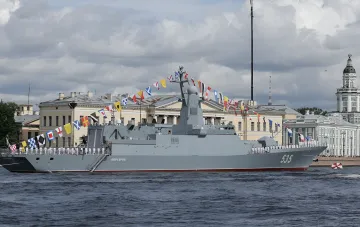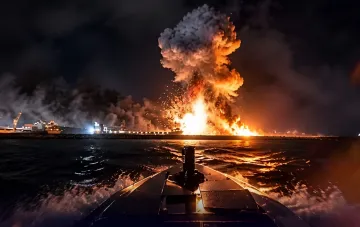
Italian Defense Minister Guido Crosetto summoned the Ukrainian military attaché on November 25, 2026, to demand explanations regarding a sea drone attack on the Russian corvette "Merkury" off the Libyan coast. According to Italian media outlets La Repubblica and ANSA, the attaché arrived for the meeting with the head of the defense department accompanied by the Ukrainian Ambassador to Italy, Ihor Brusilov. Sources for La Repubblica claim that Crosetto was "extremely irritated" and insisted that Kyiv clarify the circumstances and objectives of the strike. Rome's demarche became one of the sharpest official signals of discontent from a European capital in response to an operation conducted by Ukraine outside its territorial sea.
Context of the strike: Corvette "Merkury" and freighter near Benghazi
Recall that on November 22, 2026, Ukrainian sea drones struck Russian ships near the port of Benghazi. Ukrainian President Volodymyr Zelensky publicly confirmed the destruction of the corvette "Merkury" and demonstrated footage of the strike. According to him, a freighter, the MV ANGARA, was also hit, which Kyiv alleges was being used to transport weaponry. Thus, the operation involved both a military and a civilian (based on the vessel's classification) object, which significantly increases the diplomatic sensitivity of the incident and takes it beyond the scope of a standard maritime encounter.
Why Libya is a sensitive topic for Rome
Libya is traditionally viewed in Rome as a country critically important to Italy's national interests. Natural gas is supplied directly to Italian territory via a Libyan gas pipeline, making Rome's energy security dependent on stability in Tripoli. Beyond energy, Italy is interested in controlling migration routes from Africa and ensuring security in the Mediterranean—two areas where Libya acts as a key link. This is precisely why any strike involving parties acting in Libyan waters is perceived in Rome as directly impacting its own interests.
Reaction from Tripoli and Kyiv
The General Command of the Libyan National Army stated that two servicemen from the naval headquarters were killed in the Ukrainian attack. The command vowed to respond "in the right place, at the right time, and with the right means." Earlier, Libya demanded explanations from Ukraine and called the attack equivalent to a declaration of war. In response, the Ukrainian Foreign Ministry emphasized that Kyiv is "not transporting the war anywhere" and is acting within the framework of the right to self-defense. Thus, the parties diverge in the legal and political qualification of the incident, although the fact of the strike on targets in Libyan waters is not disputed.
Risks for the Italian contingent
About 200 Italian soldiers are currently deployed in Libya, participating in the Miasit mission, which assists Libyan security forces. According to ANSA, Rome is considering strengthening security measures for this contingent following the Benghazi attack. This indicates that the Italian authorities assess the operation as a factor capable of increasing risks for their own personnel in the region. Summoning the Ukrainian attaché in these circumstances looks not only like a diplomatic reaction to a specific strike but also as an attempt by Rome to pin responsibility on Kyiv for the future safety of the Italian presence in Libya.