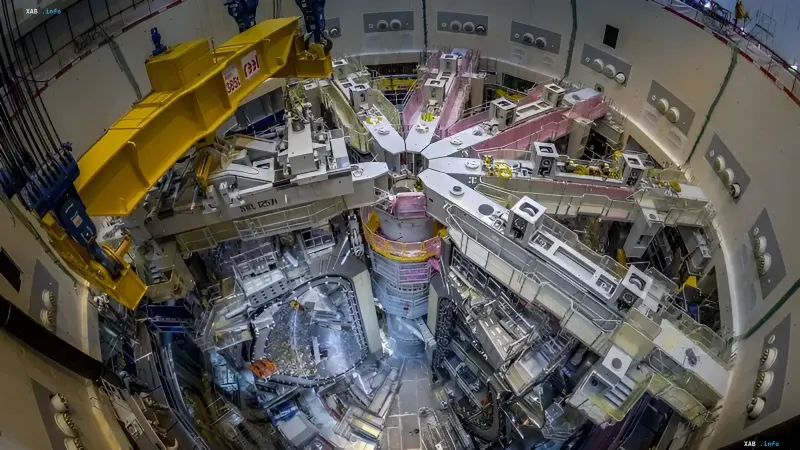
At the International Thermonuclear Experimental Reactor (ITER) facility in Cadarache, France, engineers have successfully completed tests on one of the project's largest superconducting magnetic coils—the 330-ton toroidal field coil No. 17. The component was cooled to 4 K (−269 °C), transitioned into a superconducting state, and subjected to a 34,000-amp current. According to the ITER consortium, this is a milestone step allowing experts to verify the behavior of the magnetic material, structural deformations, and the performance of contact joints under conditions closely mirroring operational reality, before the coil is permanently installed in the reactor pit where any retrofitting will be impossible.
Why Waiting for Reactor Assembly Is Not an Option
A current of 34 kA represents exactly half of the toroidal field coils' nominal operating current, with full operation targeting 68 kA while keeping the winding temperature at −269 °C. ITER engineers acknowledge that components of this scale have never before been tested under such specifications. How the superconducting material will behave under the combination of extreme cold and massive electromagnetic fields, what mechanical deformations will occur in the D-shaped structure, how the joints will perform, and what happens during partial local heating—all these questions were previously known only from computer models. Once the reactor is assembled in the pit, there will be no second chances: either the system works, or the project fails and massive investments are lost. This is precisely why the Magnet Cold Test Facility (MCTF) has become a critical element of the program, allowing each magnet and its auxiliary systems to be tested individually prior to integration into the reactor hull.
Chronology: From Coil No. 7 to Extracting No. 17
Testing of coil No. 17 began in August 2026. Before current was applied, the structure was cooled to operational temperature to ensure the superconducting transition. This is not the first campaign at the MCTF: back in May 2026, toroidal field coil No. 7 was tested at the same facility, successfully cooled to 4 K, and energized with a 10 kA current. During that campaign, engineers measured the electrical resistance of the winding joints and tested the quench detection system. The MCTF allows testing not only of the magnets themselves, but also of cryogenic equipment, vacuum systems, power supplies, busbars, and control electronics—effectively the entire supportive infrastructure that becomes inaccessible for diagnostics once the reactor is fully assembled. On October 30, 2026, coil No. 17 was extracted from the test facility and sent to storage, awaiting its turn for reactor installation.
What's Next: Coil No. 19 and Extreme Stress Testing
The next object slated for the MCTF is the spare toroidal coil No. 19. Its cooling down to 4 K is scheduled for April 2027, followed by a 34 kA current test. Subsequently, the coil will be tested at full load—running 64 kA—to verify the integrity of the high-voltage insulation across all contacts. Under full operating regimes, the risk of deformation from intense magnetic fields increases significantly, so the coil will be reinforced with an additional structural framework prior to stress testing. Temperature tests are also planned, deliberately heating sections of the winding to check the superconducting stability margin and the effectiveness of protection systems. Because coil No. 19 is a reserve unit, testing beyond standard regulatory parameters is permitted—an option unavailable to the primary operational units.
Context: 18 Toroidal Coils and Multinational Assembly
The ITER reactor design incorporates 18 D-shaped toroidal field coils, six poloidal field coils, and a central solenoid. The central solenoid, whose magnetic field could theoretically lift an aircraft carrier, was manufactured in the United States, while one of the largest poloidal field coils was produced in Russia. Thus, every component tested at the MCTF represents a triumph of multinational cooperation, with successful verification mitigating systemic risk for the entire project.
Delayed Timelines and the Path to Q=10
The ITER project has experienced significant delays relative to its original schedule. In 2024, the start of the reactor's scientific operation was pushed back to 2034. The initial plan envisioned first plasma as early as 2025, but the COVID-19 pandemic, supply chain disruptions, and the need to correct manufacturing defects in critical components—specifically the vacuum vessel and thermal shield—pushed the timeline back substantially. Initial experiments will utilize hydrogen and deuterium plasma, a more challenging scenario than originally anticipated in the earliest project framework. Full power and a nominal plasma current of 15 MA are slated for 2036, with deuterium-tritium experiments scheduled to begin in 2039. It is at this stage that the project aims to demonstrate 500 MW of fusion power output with 50 MW of plasma heating input, achieving an energy gain factor of Q=10. The start of the deuterium-tritium program has been postponed by four years compared to the 2016 schedule. Nevertheless, the successful completion of MCTF tests by coil No. 17 is a concrete, measurable step confirming that ITER's magnetic system performs in line with theoretical models, and the project continues its march toward its ultimate physics goals despite calendar adjustments.