In August 2026, the astronomical community received data capable of overturning the understanding of the evolution of the Universe. Using the James Webb Space Telescope (JWST), scientists identified a unique object, MoM-BH*-1, dated to an epoch only 660 million years after the Big Bang. The object, with a confirmed redshift of z=7.7569, was classified as a new class of astrophysical sources, named 'black hole stars'.
The phenomenon of 'Little Red Dots' and the mysterious spectrum
Visually, the object MoM-BH*-1 appears as one of the so-called 'Little Red Dots', the mass detection of which became one of the main mysteries of the Webb observational program over the last two years. However, detailed spectral analysis showed that the nature of this source is radically different from known astrophysical objects. The spectrum of MoM-BH*-1 demonstrates features characteristic of stars, yet the energy indicators suggest that such stars cannot exist in nature.
A key feature of the object is the presence of a pronounced Balmer jump in its spectrum — a phenomenon typical of stellar photospheres. At the same time, only hydrogen and helium were detected in the spectrum, with no signs of heavier elements. This rules out the version that we are dealing with an ordinary nebula or a standard accretion cloud around a black hole, where spectral lines are usually distorted or absent.
Mechanism of operation: accretion instead of thermonuclear fusion
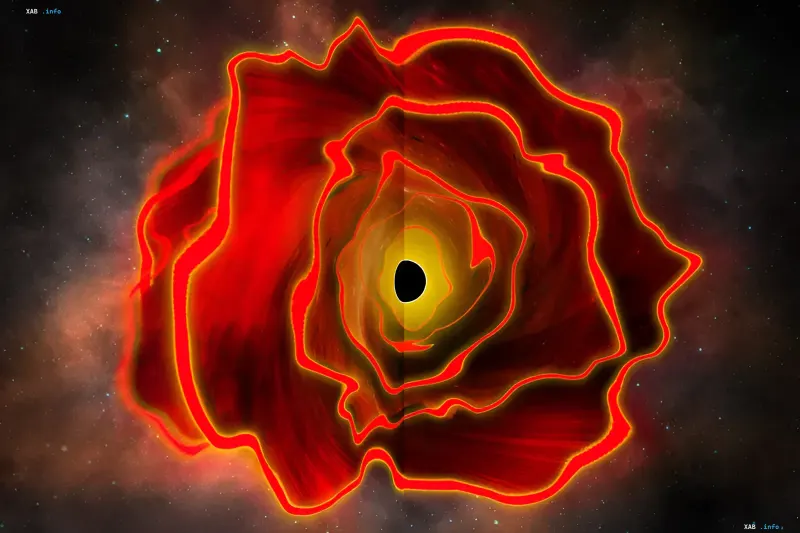
Astrophysicists have concluded that the observed object represents a supermassive black hole hidden inside a giant, ultra-dense gas shell. The size of this shell is comparable to the scale of our Solar System (about 10–100 a.u.). The luminosity of the object is 100 billion times higher than the limiting luminosity of the brightest possible star. This means that the source of energy cannot be nuclear fusion, as in ordinary stars.
Instead, colossal energy is generated through the accretion of matter — the falling of gas onto the central black hole. The gas shell is so dense (density reaches 10¹¹ cm⁻³) and opaque that it begins to play the role of a photosphere itself, creating the illusion of a star. It is precisely the dense hydrogen gas that absorbs part of the radiation, giving the object its characteristic red color, rather than dust, as is generally believed for other red dots.
Solving the problem of the growth of supermassive black holes
The discovery of MoM-BH*-1 is of fundamental importance for cosmology. It can explain one of the main problems of modern astrophysics: how supermassive black holes with a mass of a billion solar masses appeared in the Universe less than a billion years after its birth. Standard growth models cannot explain such a rate of mass accumulation.
Modeling showed that the 'black hole star' configuration allows the black hole to grow faster than the theoretical Eddington limit. The dense gas shell hides the true nature of the source, allowing it to absorb matter at an incredible speed. The estimated mass of the central black hole in the object MoM-BH*-1 is 10⁶–10⁷ solar masses, making it an ideal candidate for the role of 'seeds' for future giants.
Contradictory data and methodological difficulties
Despite the persuasiveness of the model, certain disagreements and difficulties in interpreting the data persist within the scientific community. The main problem lies in the accurate determination of the mass of the central black hole. Due to the unusual gas environment and multiple scattering of photons inside the shell, standard methods of analyzing spectral lines may have an error of up to two orders of magnitude (100 times).
On the one hand, the authors of the study insist that MoM-BH*-1 is an almost 'pure' example of the mechanism that generates many other 'Little Red Dots'. On the other hand, some astronomers believe that to finally confirm the hypothesis of 'black hole stars', it is necessary to accumulate statistics on other similar objects to rule out the influence of rare anomalies in spectral data. Nevertheless, the discovery of MoM-BH*-1 is already recognized as a breakthrough step in understanding the early Universe.