Direct Confrontation with Washington
Japanese Prime Minister Sanae Takaichi made an unprecedentedly sharp statement on August 25, declaring that Tokyo intends to defend the International Criminal Court (ICC) from growing pressure from the United States. "As the ICC's largest financial donor, we must protect this vital institution," the head of the Japanese government emphasized, speaking in the evening after Washington last week imposed sanctions on the President of the International Criminal Court, Tomoko Akane. According to Takaichi, Japan "shares a sense of crisis" with Akane and intends to continue supporting her, even though she is now barred from access to the US financial system and from traveling to the country.
From "Regret" to Hard-Line Rhetoric
The timeline of Tokyo's reaction to the US sanctions shows rising tension. Initially, Japan expressed only "deep regret" over Washington's actions, but on August 25 Takaichi shifted to a more blunt formulation. "We have repeatedly appealed to the United States at various levels, right up to the last moment, urgently calling on them not to impose sanctions on President Akane," the prime minister stated, adding that Tokyo would consider further approaches to the American side if necessary. This escalation in rhetoric — from diplomatic "regret" to an open pledge to "protect" the court — marked a notable shift in the position of one of the US's key allies.
A Rare Public Clash Between Allies
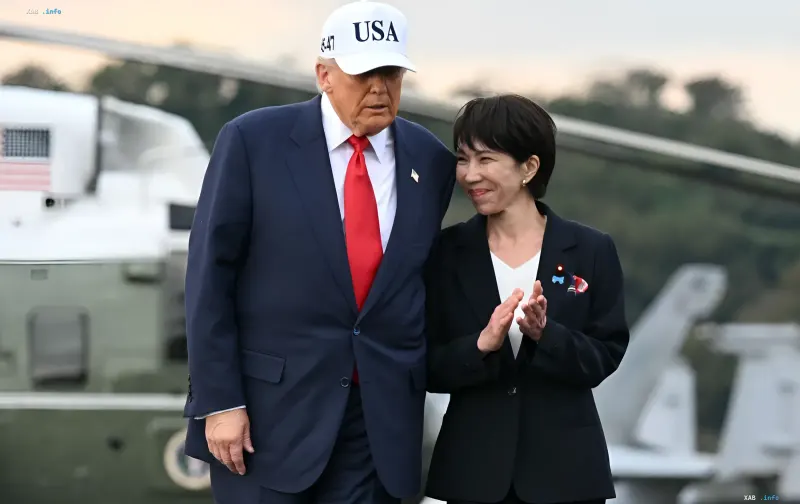
As Bloomberg notes, the intensification of relations between Japan and the US over the status of the International Criminal Court represents a rare case of public conflict between two close alliance partners. In photographs taken during Takaichi's visit to Washington, where the two sides discussed issues of global security and energy, the leaders displayed standard diplomatic courtesy — however, behind the scenes, judging by recent statements, the two sides' positions have significantly diverged. Japan, as one of the ICC's largest financial donors, finds itself in a situation where its interests within the framework of international justice directly clash with Washington's sanctions policy.
Context: Systemic US Pressure on the ICC
The sanctions against Akane and Seye are not an isolated step. As early as February 2025, shortly after Donald Trump's return to the White House, Washington imposed restrictions on the Prosecutor of the International Criminal Court, Karim Khan, who had previously issued an arrest warrant for Russian President Vladimir Putin. Last week, in addition to Akane herself, ICC senior judicial advocate Abdoulaye Seye also fell under US sanctions. Thus, the United States has been consistently and deliberately restricting the work of key figures at the court, which, in Tokyo's assessment, threatens the very existence of the institution of international criminal justice.
What Comes Next
Takaichi did not rule out that Japan will continue diplomatic pressure on Washington if the sanctions are not reviewed. For Tokyo, the issue has not only a principled but also a financial dimension: as the ICC's largest donor, Japan has an interest in preserving the court's functionality. At the same time, for Washington this conflict could become yet another source of friction in relations with a key ally in the Asia-Pacific region, where the US and Japan coordinate their positions on a wide range of geopolitical issues.