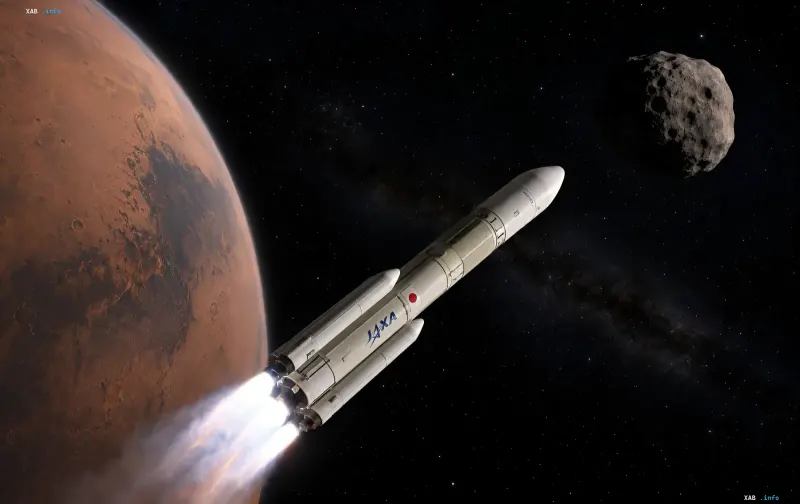
On October 20, 2026, Japan's flagship H3 launch vehicle lifted off from the Tanegashima Space Center in southern Japan, carrying the Martian Moons eXploration (MMX) spacecraft — the most ambitious space mission in the country's history. Valued at $578 million, the project's primary goal is to return soil samples from the surface of Phobos, the inner moon of Mars, for the first time in human history. The spacecraft is the heaviest interplanetary probe ever built in Japan, with a mass of 4.5 tons, two-thirds of which consists of propellant. To support the mission, the H3 launch vehicle was upgraded with an enhanced configuration featuring four solid rocket boosters and an enlarged payload fairing.
Trajectory Insertion: 71 Minutes to Separation
The rocket's upper stage accelerated the spacecraft to speeds exceeding 38,600 km/h, allowing it to escape Earth's gravitational pull. Seventy-one minutes after launch, MMX successfully separated from the launch vehicle, deployed its solar panels, and established stable communications with ground stations. The journey to the Red Planet will take 10 months, with arrival in the Martian vicinity expected in August 2027. In total, the spacecraft will spend about three years near the planet, performing a comprehensive set of scientific tasks.
Quasi-Satellite Orbit and the Idefix Rover
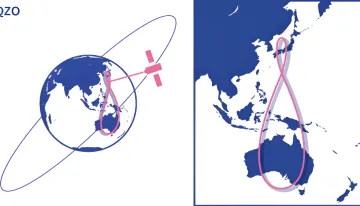
Phobos' weak gravitational field — less than one-thousandth of Earth's — combined with the powerful gravity of Mars itself, prevents MMX from entering a standard orbit around the moon. Instead, the spacecraft will maneuver along a so-called quasi-satellite orbit, requiring a series of precise maneuvers. The research will culminate in late 2028 to early 2029, when MMX will deploy the four-wheeled Idefix rover onto the surface of Phobos, developed jointly by the French and German space agencies. The Franco-German robot will operate on the moon for about 100 days, and later, in 2029, the main MMX spacecraft itself will perform two independent landings on the surface of Phobos. Scientists expect to collect at least 10 grams of material.
What the Potato-Shaped Phobos Hides
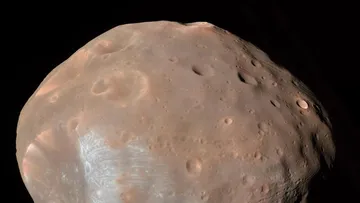
Phobos has a distinct potato-like shape with an average diameter of 22 kilometers. The scientific value of the MMX mission lies primarily in answering the question of the origin of the Martian moons: whether Phobos and Deimos are bodies captured from the asteroid belt, or debris formed as a result of Mars colliding with another celestial object. Furthermore, due to its proximity to Mars, dust kicked up by meteorite impacts on the planet itself has accumulated on the surface of Phobos for billions of years, meaning the collected samples may contain primordial traces of Martian soil, opening a unique window for studying the geological past of the Red Planet.
The Return Journey: Capsule to Land in South Australia
The return flight of MMX to Earth is scheduled for 2030. A special capsule containing the collected samples is expected to land at a testing range in South Australia in 2031. Thus, about five years will pass from launch to the return of the samples to Earth — a timeline JAXA considers the upper limit of the mission's five-year cycle. Successful execution of the project will make Japan the first country to retrieve extraterrestrial material from a body that is neither the Moon nor an asteroid, significantly expanding our understanding of the formation of satellite systems in the Solar System.