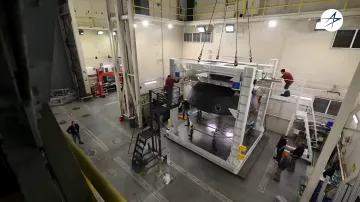
On October 19, 2026, at 22:41 Moscow time, the Martian Moons eXploration (MMX) mission will launch from the Tanegashima Space Center aboard an H3 launch vehicle. This project by the Japan Aerospace Exploration Agency (JAXA) aims to become the first expedition in history to land on a Martian moon and return soil samples to Earth. If weather or technical conditions prevent a launch in the primary window, a backup window remains open until November 7. On board the spacecraft are two sampling devices, one of which—the P-sampler—was created with the direct participation of The Planetary Society and is the result of years of collaborative work by Japanese, American, and European engineers.
The main question: asteroid or fragment
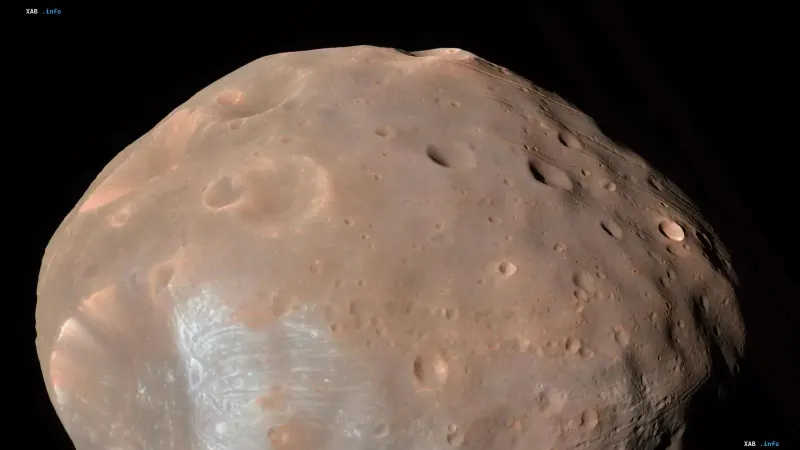
The central scientific goal of MMX is to answer a question that has divided planetary scientists for decades: are Phobos and Deimos asteroids captured by Mars' gravity, or are they fragments ejected as a result of a large body colliding with the planet's surface? The answer will not only clarify the history of the Martian system's formation but also enhance our understanding of how planetary moons arise and evolve. To find out, the spacecraft must not simply fly by, but physically collect a soil sample from the surface of Phobos and deliver it to Earth for laboratory analysis, a feat no mission has achieved to date.
PlanetVac: the "reverse vacuum" funded by crowdfunding
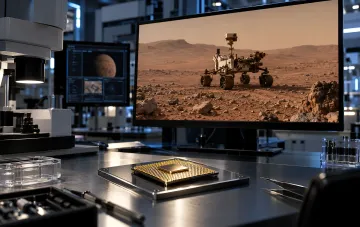
One of the mission's key instruments, the P-sampler, is based on the PlanetVac technology developed by Honeybee Robotics (a division of Blue Origin since 2022). The device's operating principle is paradoxical: instead of pressing a tool into the soil, it uses a jet of pure nitrogen to lift a cloud of particles, while a second jet drives them into a collection trap. The Planetary Society funded the project twice at critical stages—first for the entire project, and then for flight tests. Honeybee Robotics Vice President Kris Zacny recalled that in 2013, when the foundation funded the first prototype, "everything turned from a PowerPoint presentation into a real, tangible thing." In 2018, PlanetVac was tested on the Xodiac rocket, which simulated a vertical landing, and later a version of the device was selected by NASA for the Firefly Blue Ghost 1 mission, successfully collecting lunar samples in 2025—a result Zacny called "almost magic" because the landing was uneven and the device did not physically sit flush against the surface.
Operational scenario at Mars: orbit, rover, landing
After arriving at Mars, MMX will spend about a year in orbit, mapping Phobos and studying the chemical composition of its surface. Then, the IDEFIX rover, developed by the space agencies of France and Germany, will be deployed to the moon to perform reconnaissance and prepare the landing site. Only then will MMX perform a landing on Phobos, collect samples with both samplers, and, depending on the results, may perform a second landing at a different location. This multi-stage scenario allows for risk reduction: the preliminary reconnaissance rover eliminates the possibility of landing the spacecraft in an unsuccessful or dangerous area.
Return to Earth: 2030–2031
The return from Mars orbit is scheduled for 2030. On the way back, the spacecraft will perform a flyby study of Deimos, allowing both moons to be compared within a single mission. The capsule with Phobos soil samples is expected to separate and land by parachute in Australia in 2031. Successfully executing this scenario will make MMX the first mission to return material from a body that is a moon of another planet, providing scientists with a unique opportunity to determine the origin of the Martian moons using methods unavailable through orbital or landing observations.