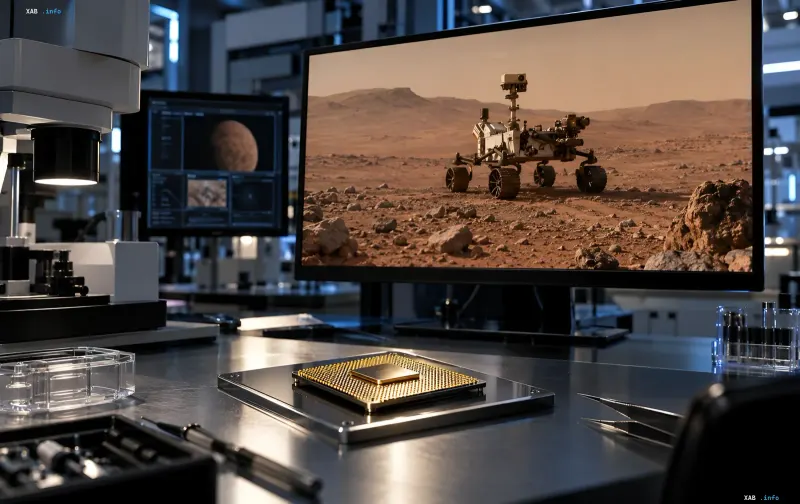
Japanese researchers have introduced a compact microchip capable of detecting molecular traces of life in material samples with an accuracy of over 80 percent. The device analyzes individual amino acid molecules and determines whether they are of biological origin. The results of the work have been published in the peer-reviewed scientific journal Nature Communications, as reported by RBC-Ukraine. The development aims to solve one of the key problems of modern planetary science: traditional equipment for chiral amino acid analysis is bulky and requires complex sample preparation, making it virtually unsuitable for installation on board spacecraft.
Mirror Forms of Amino Acids as a Marker of Life
The new method is based on studying amino acids — the so-called "building blocks" of proteins and all known organic matter. These molecules exist in two mirror (chiral) forms: left-handed (L-form) and right-handed (D-form). In inanimate nature, both forms are produced in equal amounts, whereas all known living organisms predominantly use left-handed amino acids. It is this asymmetric distribution that serves as one of the most reliable biosignatures: if the L-form predominates in a sample, it indicates the possible biological origin of the substance. Previously, such an analysis required bulky chiral chromatographs and spectrometers occupying entire laboratory racks.
Gold Nanowires and the Quantum Effect
The Japanese team found a fundamentally simpler and more compact solution. The scientists placed two microscopic gold wires at an extremely close distance from each other. Due to the quantum tunneling effect, a weak electric current arises between them. When a solution with amino acids hits the chip, each molecule alters this current in its own way — effectively forming a unique electrical "fingerprint" of a specific chiral form. Artificial intelligence algorithms read these fluctuations and determine the molecule's form with an accuracy of over 80 percent, which is comparable to the results of large laboratory setups.
Field Tests: Murchison Meteorite and Atacama Desert
The researchers tested the device's performance on real samples. The microchip analyzed fragments of the Murchison meteorite — a famous chondrite that fell in Australia in 1969 and contains over 70,000 different organic compounds, including amino acids. Simultaneously, soil samples from the Chilean Atacama Desert, considered one of the closest terrestrial analogs to Martian conditions, were tested. In terms of analysis accuracy, the compact device was not inferior to large laboratory instruments, confirming its suitability for field and, prospectively, space conditions.
Prospects for Space Missions
At the current stage, scientists are preparing the chip to recognize molecules with which the system has not previously worked, expanding the range of detectable biosignatures. In the long term, researchers are confident that compact scanners of this type can be installed on Mars rovers, lunar transport modules, and automatic probes to search for possible signs of life on Mars, the moons of Jupiter and Saturn, and other celestial bodies. For next-generation missions planned for the end of the decade, this could become a breakthrough tool enabling on-site chiral analysis without the need to return samples to Earth.
Context: Why This Matters for Planetary Science
The search for biosignatures remains one of the main tasks of modern astronomy and biology. After the Perseverance rover began collecting samples in Jezero Crater and NASA's Europa Clipper mission approached the study of Europa's subsurface ocean, the need for lightweight and autonomous analytical tools became critical. The Japanese development fits into this logic: instead of sending a heavy chromatograph into orbit or to the surface of another planet, a mission can carry a credit card-sized chip capable of answering the question of the chiral asymmetry of discovered organic molecules in minutes. Publication in Nature Communications confirms that the method has passed independent peer review and is recognized as a significant contribution to planetary science tools.