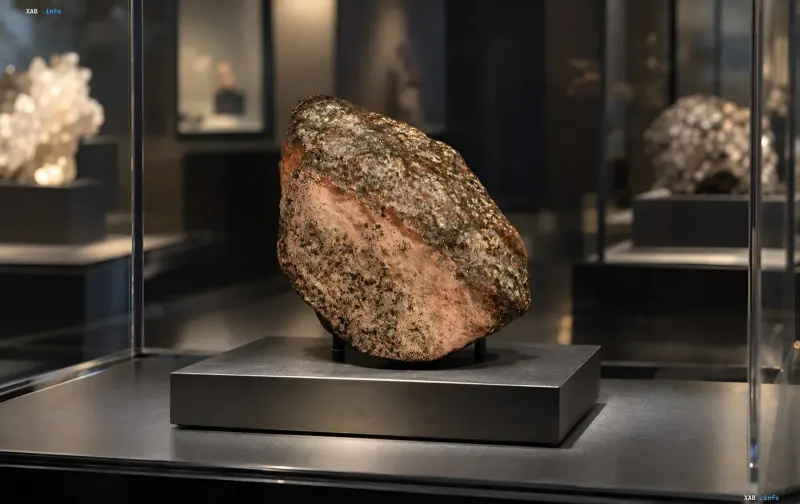
An unassuming 800-gram stone discovered in the Mali Desert has turned out to be a meteorite of Martian origin, according to a NASA study. Scientists from NASA's Jet Propulsion Laboratory (JPL) and the University of New Mexico concluded that this rock belongs to some of the oldest samples of Martian crust ever to reach Earth's surface. According to the researchers, the find opens up entirely new access to studying the geological history of the Red Planet and has already earned the unofficial moniker of the «Rosetta Stone for Mars» within the scientific community.
An Isotopic «Fingerprint» Confirms Origin
The key step in identification was comparing the oxygen isotopic composition of the found rock with the database of known Martian meteorites. JPL and University of New Mexico specialists performed a detailed isotopic analysis and established a complete match with the characteristic «fingerprint» of Martian rocks. In addition to the isotopic data, the stone's mineral and chemical composition points to a Martian origin: volcanic minerals with a characteristic zircon content match the spectrum recorded by the Mars Reconnaissance Orbiter during its mapping of Mars' southern highlands. The combination of these independent lines of evidence allowed researchers to attribute the find to the Red Planet with a high degree of confidence.
4.1 Billion Years of Water on Mars
The scientific value of the find is especially highlighted by radiometric dating performed on a tiny fragment of the rock. It was shown that water altered the mineral structure in this stone approximately 4.1 billion years ago. Meanwhile, the geological formation to which the sample belongs may be even older. For planetary geology, this means that liquid water capable of processing volcanic minerals was already present on Mars during an era that predates the formation of most known lunar and terrestrial rocks. The team led by Yang Liu of JPL emphasizes that the dating method applied to this sample is planned to be replicated on other Martian meteorites, allowing for a more detailed chronology of the planet's early hydrological history.
The 436th Martian Meteorite and Unknown Ejection Circumstances
Prior to this find, there were 435 Martian meteorites on record that had fallen to Earth. All of them, according to the accepted model, were blasted off the surface of the Red Planet by powerful asteroid impacts whose energy accelerated the rock fragments to orbital velocity. The new stone has become the 436th confirmed specimen. However, the exact location on Mars from which this fragment was ejected and the chain of events that brought it to the Mali Desert remain unknown at this time. Mineral similarities with data from the orbital probe allow researchers only to broadly link the meteorite to the southern highlands, but do not pinpoint a specific crater or geological structure.
Why the Find Is Called the «Rosetta Stone»
Researchers use the term «Rosetta Stone for Mars» metaphorically: much like the ancient Egyptian stele with a trilingual inscription provided the key to deciphering hieroglyphs, this meteorite grants access to studying the ancient crust from previously unexplored areas of the Red Planet. Unlike samples returned by the Viking or Apollo missions (the latter from the Moon), Martian meteorites found on Earth represent the only physical material from the Martian surface available for laboratory analysis without organizing a crewed or automated sample return mission. Scientists note that despite the indirect nature of clues regarding the rocks' origin, each new confirmed specimen narrows the range of possible interpretations and brings us closer to understanding what water was like on Mars in its early history.
Context and Outlook
The find fits into the broader context of NASA's planetary program, under which orbiters and surface rovers continue to map the mineralogical diversity of Mars. Combining remote sensing data with direct analysis of meteorite samples on Earth remains one of the few available methods for paleogeochemical modeling. The JPL team intends to publish an expanded isotopic dating methodology in the coming months, allowing other laboratories to reproduce the results and potentially revise the age of several previously studied Martian meteorites. In the meantime, the 800-gram stone from Mali, resting on a dark pedestal in a display case, continues to stand as one of the oldest physical pieces of evidence that water flowed on Mars billions of years ago.