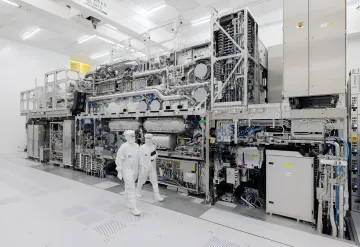

Atsuyoshi Koike, President and CEO of the Japanese company Rapidus Corp, made an unprecedented statement at an event held at the Hudson Institute research center in Washington. According to XBT.com, Koike announced that the company is seriously considering the possibility of building a semiconductor manufacturing plant directly on the lunar surface by 2040. The key condition for the project's realization, according to Rapidus's head, is the presence of local water resources necessary for the technological processes of microchip production. Koike emphasized that his statement is not a joke and showed the audience a special video clip featuring a visual representation of the future lunar production complex.
Strategic Partnership with IBM and a Bet on 1-Nanometer Chips
Arvind Krishna, CEO of IBM, also took part in the same event and confirmed that Rapidus and IBM are conducting joint research and development work. According to him, the cooperation between the two companies covers not only the implementation of existing technologies but also the development of fundamentally new semiconductor solutions in the 1-nanometer range. The idea of producing chips in outer space, as noted at the event, is being considered a logical continuation of these high-tech processes and a natural next step in the evolution of the semiconductor industry.
Dependence on Water Resources and Technical Challenges
The realization of the lunar factory directly depends on the presence and accessibility of water resources on the surface of Earth's satellite. The water cycle is a critically important component of most semiconductor manufacturing processes, including crystal cleaning and equipment thermal regulation. Creating industrial facilities beyond Earth's jurisdiction poses a number of unsolved challenges for engineers: from ensuring the hermeticity of production lines in vacuum conditions to organizing logistics and power supply. Nevertheless, as Rapidus's management emphasizes, overcoming these barriers could radically change the vector of development of the global technology market.
Context: Connection to SpaceX's Space Program
In his speech, Koike separately mentioned entrepreneur Elon Musk and his company SpaceX, which is actively working on the tasks of delivering people and cargo to space. The mention of Musk was made in the context of the fact that the large-scale initiative to create lunar production will undoubtedly attract attention and interest from the space industry. Although Rapidus has not announced a formal partnership with SpaceX, the very fact of publicly linking the project to the US space program indicates that the Japanese company is considering lunar production as part of a broader ecosystem of commercial development of near-Earth space.
Long-Term Strategy and Prospects
At present, the initiative to build a lunar factory remains at the stage of long-term strategic planning. Neither Rapidus nor IBM has published detailed technical reports, budget estimates, or an approved project roadmap. Nevertheless, the public discussion of the idea at the level of the CEOs of leading technology companies in Japan and the United States indicates that the semiconductor industry is already laying the foundation for the transition from terrestrial to extraterrestrial production. The cooperation between Rapidus and IBM, according to event participants, is aimed not only at creating the most advanced chips on Earth but also at taking humanity's capabilities in the space industry to a fundamentally new level.
Contradictory Data
The provided sources show a significant difference in the degree of certainty of the statements. On the one hand, Koike directly stated that the company is "seriously considering" the construction of the factory and demonstrated a visualization of the project, which can be interpreted as the existence of a specific plan. On the other hand, neither the Rapidus statement nor the IBM comments contain information about allocated funding, an approved construction schedule, technical expertise, or coordination with space agencies. Thus, there is a gap between the public image of a "specific project by 2040" and the actual status of "strategic consideration," which the sources do not resolve. In addition, in the XBT.com materials the project is described as a "considered possibility," whereas the zamin.uz headline uses the more categorical formulation "Japan plans to build," which creates a false impression of the certainty of intentions.