
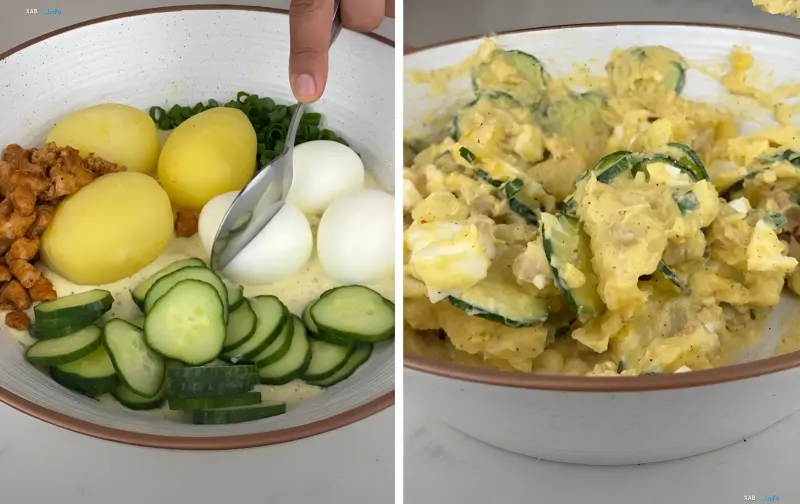
Japanese potato salad has long ceased to be an exotic dish for Ukrainian and European cuisines, yet most people are accustomed to preparing it using simplified methods borrowed from the Soviet tradition. Meanwhile, the authentic version differs not only in its ingredients but also in its fundamentally different texture: thick, creamy, almost pâté-like, yet still light thanks to a special dressing. It is this approach to preparation that blogger raziyyz examined in detail in their Instagram account, while the Styler project from RBC-Ukraine published the recipe with a step-by-step description of each stage. The dish is built on familiar products: potatoes, eggs, chicken breast, and fresh cucumber, which, combined with a yogurt-based dressing, create a balanced, filling, yet not heavy salad.
The Secret of the Creamy Texture: Why Mashing with a Fork Matters
The main difference between Japanese potato salad and the familiar "Olivier-like" version lies not in exotic spices but in the mixing technique. The cooked potatoes and eggs are not cut into cubes but are mashed with a fork directly in the bowl together with the other ingredients. It is precisely this action that turns the individual components into a single creamy mass, while still preserving small pieces of cucumber, chicken, and green onion. The result is a salad that in consistency resembles a thick cream, yet remains structured and does not turn into a uniform purée. In the photos published in the Styler article, you can clearly see a fork mashing a boiled egg in a bowl with whole potatoes, cucumber slices, and chopped onions, while the second frame shows the finished result: a delicate, velvety mass with visible bits of ingredients.
Preparing the Ingredients: Potatoes, Eggs, and Chicken
The recipe does not require complex or rare products, but each stage of preparation has specific requirements. The potatoes are boiled in their skins: for small potatoes, 15–20 minutes after the water boils is enough, and doneness is checked with a fork — the potato should pierce easily. The eggs are boiled for about 8 minutes so that the yolk remains tender and does not take on a grayish tint; after boiling, they are cooled and peeled. The chicken breast can be prepared in any convenient way — boiled or baked until fully cooked, then cut into small pieces. The fresh cucumber is sliced thinly, and the green onion is chopped into small rings. All the components are transferred to a large bowl, where the final mixing takes place.
A Greek Yogurt-Based Dressing: Lightness Instead of Heaviness
It is the sauce that makes Japanese potato salad truly delicate and gives it a light piquancy without overloading the dish with fat. For the dressing, Greek yogurt, mustard, light mayonnaise, milk, and honey are mixed together. Salt, pepper, and chili flakes are added for moderate spiciness. Optionally, a little vinegar can be poured into the sauce — it will give the dressing an extra tang and balance the sweetness of the honey. This combination allows you to obtain a creamy but not heavy base that coats every piece of potato and chicken without turning the salad into a calorie-dense "mayonnaise" version familiar to post-Soviet cuisine.
Serving and Caloric Content: What to Know
The finished salad can be served immediately after mixing or slightly chilled in the refrigerator so that the texture becomes even denser and more uniform. According to the recipe's author, one serving (when the total amount is divided in half) contains a certain number of calories, however, the exact figures are not provided in full in the published Styler article. The editors emphasize that the caloric content can vary significantly depending on the fat content of the milk, yogurt, and mayonnaise used, as well as on the size of the potatoes and the portion of chicken breast. Thus, if desired, the recipe can be easily adapted to one's own dietary preferences by choosing lower-fat dairy products or increasing the proportion of vegetables.
Context: From Olivier to Japanese Classics
Japanese potato salad, known in Japan as "yama-imo" or simply "poto-saru," historically traces back to recipes adapted from European cuisine during the Meiji period and beyond. Ukrainian and Russian culinary publications in recent years have been actively drawing attention to this dish, emphasizing its difference from the familiar Olivier salad: there is no sausage, peas, or pickled cucumbers here, and the focus is on fresh vegetables, a delicate texture, and a balanced dressing. The Styler project, positioning itself as the entertainment and lifestyle direction of RBC-Ukraine, regularly publishes such recipes, combining practical usefulness with visual presentation. The article is accompanied by photographs of the preparation process and the finished dish, allowing the reader to visually reproduce each stage.