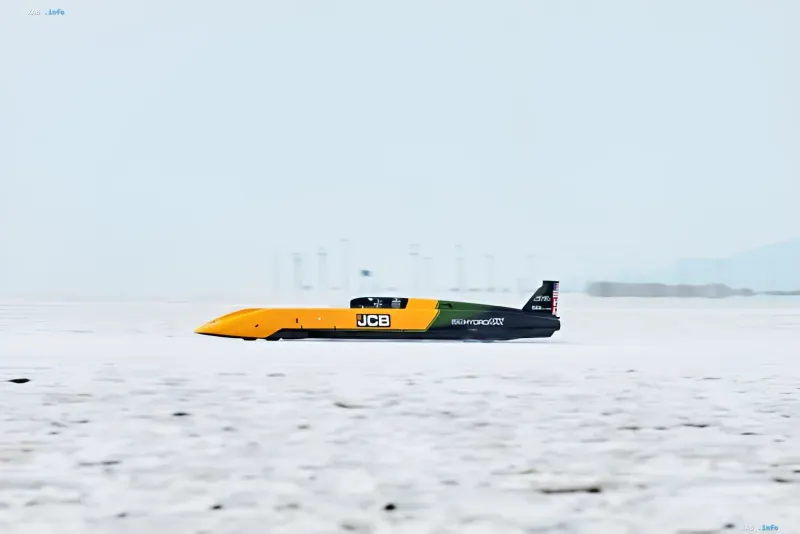
On August 11, 2026, an event took place on the vast Bonneville Salt Flats in the USA that will forever go down in the history of motorsport and engineering. The British experimental vehicle JCB Hydromax, driven by the legendary Andy Green, set a new world speed record for vehicles with a hydrogen internal combustion engine. The figure was an impressive 406.320 miles per hour (654 km/h). This achievement not only updated the statistics but also became powerful proof of the viability of hydrogen technologies under extreme conditions.
Historical Breakthrough: From 2004 to 2026
The record, recorded by the Fédération Internationale de l'Automobile (FIA), was the result of years of work. The previous achievement for hydrogen ICEs was 298.5 km/h and had been held for more than two decades — since 2004. JCB Hydromax not only doubled this result but also confidently surpassed the mark of 303 miles per hour (487.6 km/h), previously set by a hydrogen fuel cell vehicle. This was the first time a hydrogen ICE demonstrated such dominance over alternative systems in the race for speed.
Technology: Production Engines in a Record-Breaking Car
The key feature of the project is the use of not experimental prototypes, but adapted production engines. The 32-foot (9.75-meter) car is equipped with two engines producing a total of 1660 horsepower. These are the same engines that JCB installs on its excavators and construction equipment as part of a massive hydrogen program worth 100 million pounds. JCB Chairman Lord Anthony Bamford, who initiated the project, emphasized: "The record was set on production engines — the same ones that are currently powering JCB excavators. That is the whole point of Hydromax: hydrogen works, it works today, at the highest level, with zero emissions".
Legend Behind the Wheel: Andy Green Back on Top
Behind the wheel of Hydromax sat Andy Green — the only person in history to break the sound barrier on land (in 1997 on Thrust SSC). For him, this record became a logical continuation of his career, adding an achievement on alternative fuel to his resume. "This is a historic milestone for motorsport, demonstrating how innovation, performance, speed, and sustainability can go hand in hand," Green said after the run. FIA President Mohammed Ben Sulayem also highly rated the result, calling it an important step for the future of sustainable mobility.
Conflicting Data
While the main record (654 km/h) is confirmed by the FIA and agreed upon by all sources, there are minor discrepancies in the figures cited by various media outlets. While British publications (Autocar, The Construction Index) and the official JCB statement record the speed at 406.320 miles per hour (654 km/h), a number of international sources, including the AutoIndustriya portal, cite the figure 653.90 km/h. The difference of 100 meters per hour is likely due to rounding when converting miles to kilometers or using data from different telemetry sensors, but this does not affect the status of the record, which is recognized as absolute.
The Future of Hydrogen Energy
Success on the Bonneville Salt Flats became a catalyst for further investment. JCB announced that the record precedes the official announcement of the creation of a new manufacturing complex for hydrogen technologies. This confirms the company's strategy to move from demonstration projects to the mass implementation of hydrogen solutions in heavy industry and transport, proving that "green" energy is capable of withstanding extreme loads.