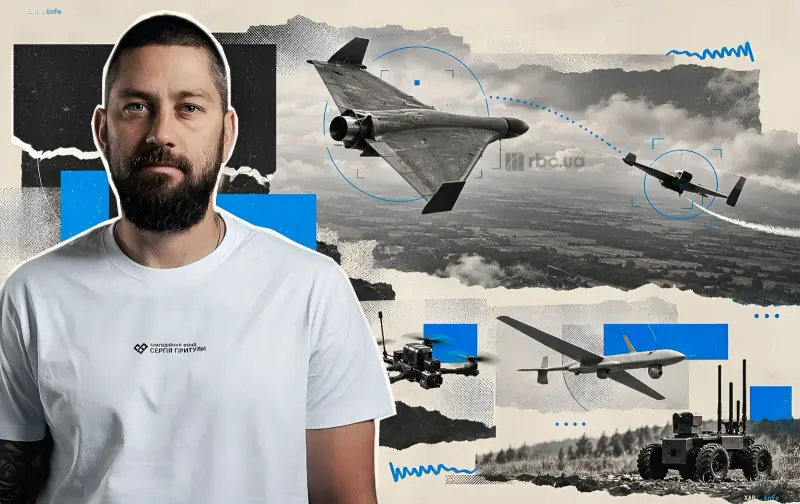
Against the backdrop of Russia's mass use of jet-powered suicide drones to strike Ukrainian territory, the question of air defense resilience has once again become one of the key issues on the military-technical agenda. In an interview with RBC-Ukraine, Kirill Lyukov, head of the unmanned technologies department at the Serhiy Prytula Foundation, broke down how the role of drones in the war is set to change, why procurement is increasingly shifting toward automation, and what tools are being put in place today to counter jet-powered targets. In his words, FPV drones are “one hundred percent relevant today,” but the vector of development is already shifting toward autonomous systems, and the Defense Forces have working countermeasures against jet-powered Shaheds that are undergoing testing.
The future of FPV: from operator to autonomous swarms and “loitering drones”
Lyukov emphasizes that in the context of the Ukrainian war, drones will not lose their relevance, but the path forward lies through automation. Among the likely scenarios, he cites autonomous swarms carrying out a designated mission, as well as so-called “loitering drones” operating in autonomous mode. In his assessment, the drone of the future will be equipped with a set of sensors, will be able to independently identify a target and carry out a mission according to a given pattern — either fully autonomously or with minimal human intervention. The expert believes that within a few years, such developments, which already exist, will become a mass reality, and the world's leading armies will likely move to automated drones; at the same time, in regions such as the Middle East, in his words, models that are already outdated in Ukraine will continue to be used for a long time.
How the Foundation selects drones for large-scale procurement
In the past, Lyukov says, samples were taken to a training ground for hands-on testing: technical and flight characteristics were checked, including under suppression by various electronic warfare systems, and only then was a decision made. He calls the price factor decisive, since the Foundation accounts for every hryvnia and chooses the most transparent manufacturers with clear pricing. Today, he says, the market has formed and manufacturers have a certain credit of trust, but in parallel, full feedback is being gathered from units using drones in combat conditions on different fronts: one system may work effectively on the Zaporizhzhia direction and not work on the Donbas, and it is precisely on the basis of this data that a contracting decision is made.
Ground robotics: the speed problem and active protection
Separately, Lyukov talks about ground robots (UGVs), which today handle logistical, evacuation, and even strike missions, but whose key drawback remains speed. He notes that a number of manufacturers and entire units are already focusing on this, and a transformation toward increasing speeds is underway, which in the future will allow replacing light vehicle transport, and in terms of payload — even cargo vehicles. At the same time, he honestly points out the vulnerability: at such speeds, a UGV remains an easy target for drones, and “hardware” versus personnel are fundamentally different things in terms of value. He sees solutions in two directions — speeding up the systems and developing active protection: installing multiple sensors, additional weaponry, net launchers, and similar means that increase the chances that the target will not be destroyed.
Private air defense as part of the global security system
Talking about the prospect of involving civilian and private structures in countering UAVs, Lyukov ties it to the regulatory framework: if norms for handling explosives and working in this field are adequately codified, and companies are ready to sponsor the niche, it “certainly has a right to exist.” He considers training civilians acceptable — through corporate security services or engaged private companies, where the main question remains legal normalization. The expert cites a global trend: if a security service needs to secure a major football match, its functions used to be limited to contractual tasks, but now it has to account for the fact that a small drone could fly into the stadium “bowl” and explode — and that is precisely why private companies are forced to develop air space protection.
Jet-powered Shaheds and Ukraine's countermeasures
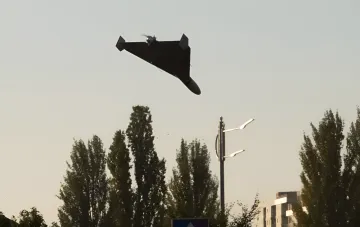
Concluding the discussion of the air threat, Lyukov characterizes jet-powered Shaheds as a new challenge for Ukrainian air defense. In the public sphere, this challenge is discussed in connection with the testing of countermeasures: according to reports by Ukrainian media, including TSN, Ukraine is testing jet-powered interceptors, and the test results are described as “very positive.” Thus, the basis of the response to jet-powered targets is the logic of “jet against jet” — interceptors capable of competing with incoming Shaheds in speed and maneuverability, which is also confirmed by visual materials of the tests, where a jet-powered interceptor accompanies and destroys a similar target against the backdrop of open terrain.
Contradictory data
The sources show a difference in emphasis. On the one hand, in the interview Lyukov consistently emphasizes that jet-powered Shaheds are a serious new challenge for air defense, and the question of countermeasures remains open in the original text, conveying an image of a growing threat. On the other hand, a number of outlets (in particular TSN and regional media) present the same theme through the prism of already obtained “very positive results” from testing jet-powered interceptors, i.e., through the prism of a working solution. The difference is not factual: it is two views on the same process — acknowledging the problem and confirming the existence of countermeasures that are being brought to operational use. In addition, the introductory part of the material mentions that foundations “do not always buy Ukrainian products,” however, in the provided interview fragment this thesis is not quantified and is limited to a general description of transparency and testing criteria, so specific figures on the share of domestic and foreign procurement are absent from the text.
The bottom line of the expert analysis is that the Ukrainian side is not in the position of a passive observer: FPV drones are evolving toward autonomous swarms, ground robotics is gaining speed and active protection, the private sector is being drawn into air space defense, and jet-powered interceptors are being developed and tested against jet-powered Shaheds. In Lyukov's assessment, it is precisely the combination of automation, feedback from the front, and transparent procurement that will determine the face of unmanned warfare in the coming years.