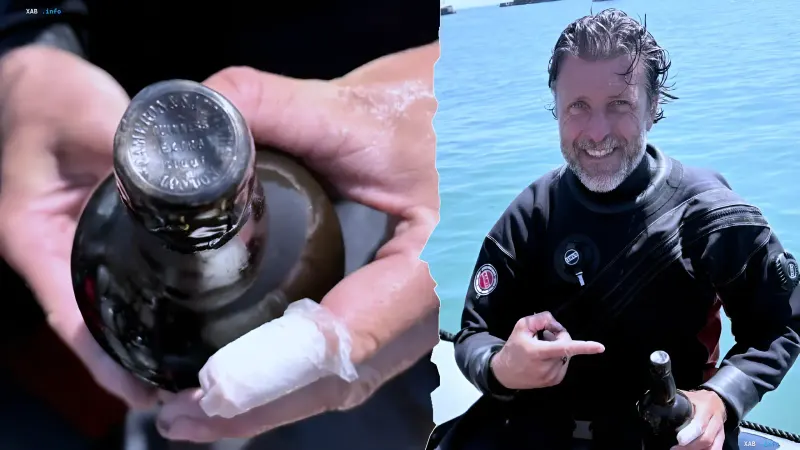
In mid-August 2026, the scientific community and the brewing industry encountered a phenomenon that could be called a "liquid time travel." At the bottom of the English Channel, off the coast of Dover, a team of technical divers made a sensational discovery: an perfectly preserved bottle of legendary Guinness stout was raised from the hold of a British sailing ship that sank in 1864. This artifact, which had lain underwater for more than 160 years, became the basis for an ambitious scientific project called "Jurassic Beer," aimed at genetically resurrecting the taste of the Victorian era.
The Mystery of the Sunken "Mindoro" and the Hydraulic Lock
The discovery was made by Belgian underwater photographer Stefan Panis and Polish historian-diver Pawel Trusinski. The researchers were working at a depth of about 30 meters in the Strait of Dover, where the remains of the three-masted barque "Mindoro" rest. The ship, which left London for Vancouver in November 1864, sank just a week after departure after colliding with another ship in thick fog. The crew survived, but the cargo of elite beer went to the bottom.
The amazing preservation of the bottle's contents is explained by unique storage conditions. As experts found out, the crates of Guinness on board were stacked upside down. Under the colossal pressure of seawater, this created a perfect "hydraulic lock": the liquid inside the bottle was pressed against the cork, blocking the pores and preventing saltwater and bacteria from penetrating inside for 162 years. On the original lead seal, the inscription "Guinness Extra Stout, London" is still clearly legible.
Project "Jurassic Beer": Recreating the Lost Strain
The discovery sparked huge interest from Diageo, the corporation that owns the Guinness brand. The bottle was handed over to the laboratory of microbiology professor Kevin Verstrepen at KU Leuven (Belgium). Scientists plan to fully sequence the DNA of the ancient yeast preserved in the dark and cold.
Although the company archives contain detailed recipes for malt and hops from the 19th century, the unique strains of Victorian yeast were irretrievably lost over time. The "Jurassic Beer" project aims to clone these microorganisms to recreate that specific thick, bitter taste that British sailors and aristocrats drank in the mid-19th century. This will be the first case in the world of genetic restoration of an alcoholic beverage.
The First Sip: Risk and Science
The fate of the drink inside the bottle is a subject of debate. Stefan Panis, the discoverer, admitted that he is not a Guinness fan, but if microbiologists give the "green light" (confirming the absence of cadaveric poisons or deadly bacteria), he will definitely take the first sip in history of Queen Victoria's era stout.
However, no one will be allowed to drink the bottle completely. Scientists will make a delicate micro-puncture to collect biological material with syringes to avoid damaging the microflora. Currently, the bottle is "resting" in Panis's garage in a special reservoir with ice water, simulating seabed conditions, awaiting final examination. The diving team is already preparing new dives to raise the rest of the sunken batch, which, by estimates, may contain another couple of dozen bottles.