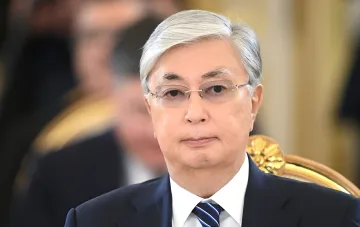
Kazakh President Kassym-Jomart Tokayev has signed a package of amendments to migration legislation that, from November 30, 2026, radically changes the conditions for crossing the border for Russian citizens. According to the text of the law, recorded in materials citing the Ukrainian Foreign Intelligence Service and passed on by RBC-Ukraine, Russians entering the republic by land through the main border crossing points will be required to obtain in advance a paid electronic permit called QazETA. The application must be submitted no fewer than 72 hours before the planned trip. Without a valid permit, a Russian citizen risks being denied entry and deported back.
The Economics of the New Order: How Much Crossing the Border Will Cost
The financial component of the reform looks as follows: the base cost of the QazETA electronic permit, obtained in advance, will be 3,900 tenge, which at the current exchange rate is equivalent to roughly 7.3 euros or about 800 Russian rubles. If the applicant decides to obtain the document directly at the border crossing point, the amount doubles — to 7,600 tenge, or about 14.3 euros. Thus, the Kazakh state is creating a direct financial incentive to plan a trip in advance, while simultaneously forming a stable source of revenue from the growing flow of Russian citizens. According to analysts' estimates, after the start of Russia's full-scale invasion of Ukraine, Kazakhstan became one of the key destinations for Russians leaving the country due to the threat of mobilization and military action. Some Russian citizens also used the republic as a platform for work and business outside Russia. The new system turns this migration flow into a source of direct budgetary revenue for Astana.
Biometric Profile and Permit Validity Period
In addition to the paid component, the reform introduces the mandatory creation of a digital profile with biometric data for each entering Russian. This means that when first applying for QazETA, applicants will be required to provide fingerprints and/or a facial scan, and the resulting data will be stored in a unified database of Kazakhstan's migration service. The permit itself will be valid for 180 days, however, actual stay on the territory of the republic is limited to 90 days. Exceeding this limit, as follows from the text of the law, will entail administrative liability and a possible ban on re-entry.
Phased Rollout: From Airports to Railways and Ports
The QazETA system will not be introduced all at once across all routes. It will first go live at Kazakhstan's international airports. By mid-December 2026, according to sources, it is planned to extend it to international railway routes and seaports. This means that during the period from November 30 to mid-December 2026, the rules for land entry through road border checkpoints may apply in a transitional mode, creating a risk of confusion for travelers. Experts recommend that Russians planning a trip during this period check the current requirements in advance on the official portals of Kazakhstan's migration service.
Beyond Kazakhstan: A Trend Toward Reducing Dependence on Russia
The introduction of paid entry for Russians is not an isolated decision by Astana, but part of a broader process of weakening the dependence of Central Asian countries on the Russian Federation. At a recent meeting of the leaders of Central Asia and Azerbaijan, Kyrgyz President Sadyr Japarov put forward an initiative to create a single tourist visa for foreign citizens. If this idea is realized, the region will gain an additional tool for managing migration flows and, potentially, a unified digital standard similar to QazETA, but already at the interstate level.
Contradictory Data
There is a discrepancy in tone and degree of certainty between various sources. RBC-Ukraine, citing the Ukrainian Foreign Intelligence Service, presents the information as a signed and already in-force law with specific dates, prices, and technical parameters. The Russian state agency TASS uses a more cautious formulation in its headline — "Russians may need a permit to enter Kazakhstan" — which allows the document to be interpreted as being at the discussion stage or subject to additional amendments. The Mail.ru and Afisha.ru portals convey the information in the affirmative, corroborating the fact of signing. Thus, the basic fact — Kazakhstan's intention to introduce paid entry for Russians — is confirmed by all sources, however, the precise technical details (the cost in tenge, the 72-hour deadline, the biometric profile parameters) currently rely predominantly on a single verification chain through the Ukrainian intelligence service, which calls for caution when citing specific figures until the official text of the law is published in the Kazakh legal register.