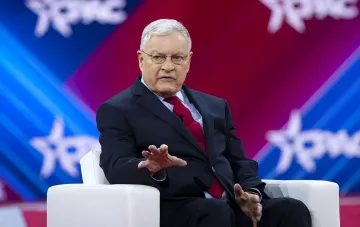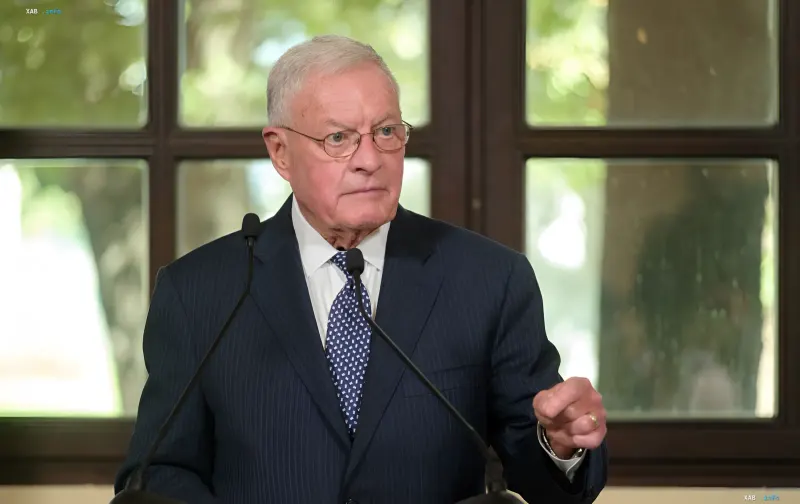
Former special presidential envoy of U.S. President Donald Trump, Keith Kellogg, in an interview with journalist Natalia Mosiychuk published by RBC-Ukraine, revealed details of the diplomatic pressure (or its absence) exerted by Washington on Kyiv over the Donbas territories. According to Kellogg, Trump personally did not pressure Ukrainian President Volodymyr Zelensky to voluntarily hand over the Donetsk region or the entire Donbas to Russia. 'It seems this became clear during the Alaska summit,' the former special envoy clarified, pointing to the key moment when the White House's position became transparent to all parties to the conflict.
Trump's Message to Moscow: 'Fight for It'
Kellogg relayed that Donald Trump delivered a concise but substantive message to Russia: 'If you want this land — fight for it.' In the interlocutor's assessment, this formulation reflects Washington's principled position, which did not become an instrument of Moscow's territorial claims, but also did not take on the role of an arbiter imposing concessions on Ukraine. Thus, Kellogg confirmed that Vladimir Putin's attempt to achieve the occupation of the entire Donetsk region through cunning and via American mediation was unsuccessful — Trump did not play the role that, by the Kremlin's design, he was supposed to.
Trump's and Putin's Personal Relations and Exhausted Diplomatic Tools
In the same interview, Kellogg noted that Donald Trump and Vladimir Putin have long-standing personal relations, which, in his words, creates a certain context for bilateral contacts. At the same time, the former special envoy emphasized that the U.S. president has already used all possible diplomatic tools to end Russia's war against Ukraine. This assessment underscores that, in Kellogg's view, the room for further diplomatic maneuvers within the current configuration of Washington–Moscow relations is virtually exhausted.
The Unfulfilled 2025 Forecast and the Dynamics of Trump's Relations with Zelensky
Earlier, in 2025, Kellogg publicly stated that the war would end within a year. This forecast did not materialize: by August 2026, the conflict is still ongoing, which calls into question the accuracy of the former special envoy's earlier assessments. At the same time, Kellogg reported a positive dynamic in the relations between Donald Trump and Volodymyr Zelensky, which, in his words, have improved. This statement contradicts the narrative of systematic Washington pressure on Kyiv and indicates that the bilateral relations between the two presidents have gone through a period of tension and are now stabilizing.
Contradictory Data
The provided sources record two significant inconsistencies. First, Kellogg's 2025 forecast about the war ending within a year was not confirmed — by August 2026, hostilities continue, making the earlier assessment outdated and raising questions about the former special envoy's forecasting methodology. Second, after Kellogg's statement about the alleged planned mobilization of women in Ukraine, the Center for Countering Disinformation (CCD) officially refuted this information, noting that forced mobilization of women in the country is not taking place and is not planned. Thus, some of Kellogg's public statements are controversial and require additional verification, while the key thesis about the absence of Trump's pressure on Zelensky over Donbas is confirmed by several media outlets — RBC-Ukraine, TSN, Gazeta.ru, and 24tv.
Context: What Is Known About the Alaska Summit
The Alaska summit, which Kellogg cites as the moment when Trump's position became clear, became one of the key events in the diplomatic track around the Ukrainian conflict. It was during this event, in the words of the former special envoy, that it became obvious that Washington did not intend to force Kyiv into territorial concessions. The details of the summit's format and outcomes are not disclosed in the provided sources, however, the very reference to it as a turning point underscores its significance in the diplomatic chronology of 2025–2026.