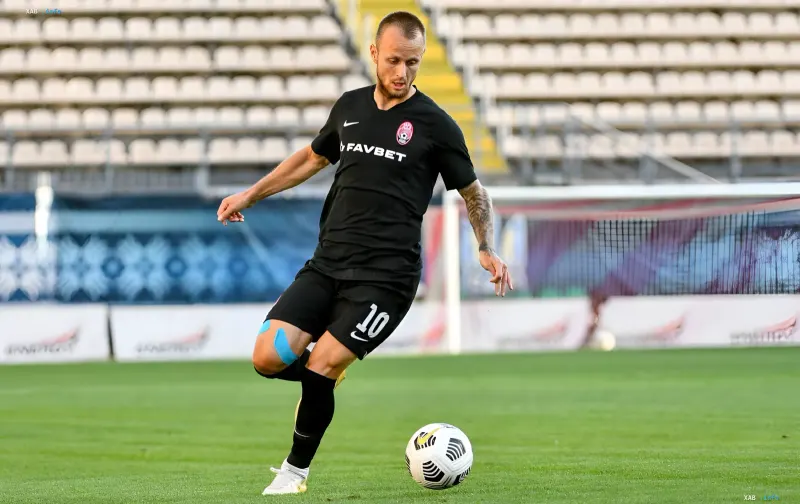
Former Zorya Luhansk and Ukraine national team midfielder Dmytro Khomchenovskyi recently recalled his first foreign experience playing for the Spanish club Ponferradina during the 2015/16 season. The former footballer, who was considered one of the most promising midfielders in Ukrainian football at the time, confessed that he faced a number of unexpected challenges ranging from a language barrier to strict coaching staff requirements regarding players' physical parameters. According to him, it was in Spain that he first encountered sanctions in his career related not to tactical errors or disciplinary violations, but to the specifics of his own body.
A transfer that happened at the last moment
Moving to Spain was the result of a chain of events for Khomchenovskyi, where his initial plan collapsed just days before signing the contract. Following successful performances with Zorya, the midfielder considered continuing his career at Polish club Jagiellonia, but the deal fell through at the last moment. Left without a specific offer, the footballer quickly agreed to an invitation from Ponferradina, which played in the Spanish Segunda Division. Thus, his first foreign contract was signed almost on the run, without thorough preparation for the move and adaptation.
Daily life, language barrier, and McDonald's before the match
Adaptation in the new city proved difficult. Khomchenovskyi noted that at the time of his arrival in Ponferradina, local festivals were taking place: practically nothing worked on weekends, and the language barrier aggravated everyday difficulties. It was hard for the Ukrainian player to find food, understand the schedules of local establishments, and generally navigate the unfamiliar environment. By his own admission, before one of the matches, he went to McDonald's, which—as he realizes in hindsight—was far from the best preparation for a game. Nevertheless, it was during this period that Khomchenovskyi began actively learning Spanish, which he eventually mastered well enough for everyday communication.
Body fat as a reason for being dropped from matches
The most unexpected and, according to the footballer himself, the most serious test was the coaching staff's requirements regarding physical shape. Ponferradina was extremely strict about body fat percentage: Khomchenovskyi was told that until his figure dropped to 10.5%, he would not be included in the matchday squad. At the time of his arrival at the club, his body fat was 14%. "I was suspended from games and even some training sessions because of my body fat percentage. They said that until it was 10.5%—and I had 14% at the time—I wouldn't make the matchday squad," Dmytro said. For a Ukrainian footballer accustomed to a different system of physical conditioning control, such an attitude toward body composition metrics came as a genuine cultural shock.
Two days off mid-week: training methods in Spain
The approach to the training process itself differed significantly from the usual realities of Ukrainian football. Under Yuriy Vernydub at Zorya, the workloads were exhausting and regular, whereas in Spain the team could get two or three days off in a row right in the middle of the week. When Khomchenovskyi expressed a desire to train extra, the coaching staff advised him to rest more, sleep properly, and eat right. At the same time, due to a lack of communication at the initial stage, the Ukrainian did not immediately understand the mentors' tactical requirements. "By the time I understood what they wanted from me, I had already left the team," he summarized with humor. Ultimately, during the 2015/16 season, Khomchenovskyi played 17 matches for Ponferradina without making any goal contributions.
A short experience that paid off
Despite the fact that his career in Spain did not last long, Khomchenovskyi acknowledges that this experience proved valuable. He managed to learn Spanish, get acquainted with a different philosophy of preparation and daily life, and gain an understanding of how professional football is structured in another country. For a footballer who was just beginning his journey outside of Ukraine in 2015, even a short spell in the Segunda Division became an important stage of personal and professional development. Today, Khomchenovskyi—whose career continued at other clubs—remembers Ponferradina without resentment, rather as an interesting chapter where he learned more about himself and world football than he expected.