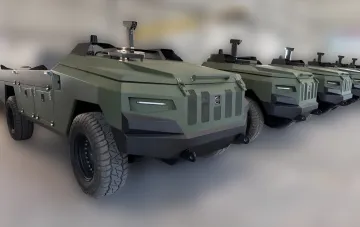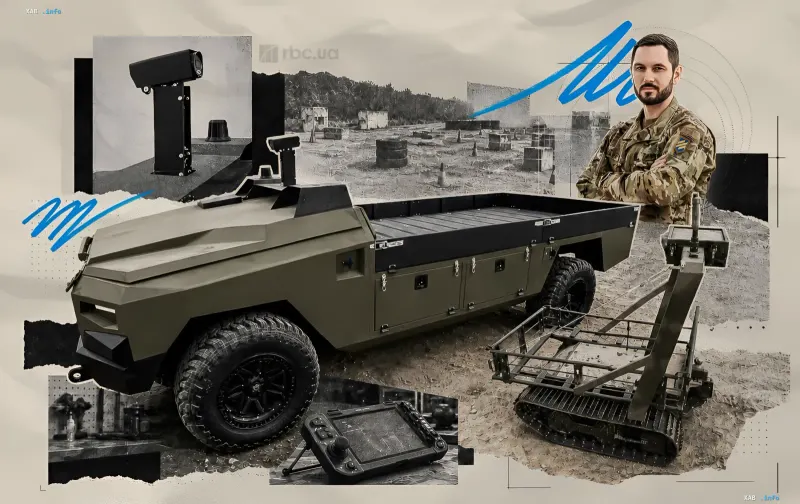
In August 2026, the KILLHOUSE Academy School of Ground Robotic Complexes received the heavy unmanned complex Protector, handed over by the company "Ukrainian Armored Vehicles." At the same time, a second identical unit was sent to a combat unit of the 3rd Army Corps. The school's founder, an officer of the UGV battalion of the 3rd Separate Assault Battalion of the Third Army Corps, Viktor Pavlov (callsign "Stark"), told RBC-Ukraine in an interview exactly how the large complex will be used in the training process, and also revealed details about the school's funding and the current problems with the state certification system for operators.
Tactics of use: logistics instead of a pickup
According to Pavlov, the tactics of using the large UGV Protector revolve around a logistics task. The complex delivers significant volumes of cargo to intermediate resupply points, where the cargo is transferred to smaller ground drones, which then distribute it across the positions. In addition, the Protector is capable of bringing the ground robotic complexes themselves closer to the area of operations, effectively performing the function of a pickup and ensuring resupply without involving personnel. "The main advantage of large UGVs is that they can carry significant volumes of cargo and cover long distances," emphasized the school's founder. At KILLHOUSE Academy, the Protector will be used as a demonstration tool: trainees get acquainted with the operation of the large complex and master the skills of controlling it.
Drawbacks of the large platform
Alongside the advantages, Pavlov pointed to a number of significant limitations. The larger the platform, the harder it is to camouflage and the easier it is to detect from the air, which increases the risk of being hit by the enemy. A large UGV is also more difficult to transport, store, and repair, as its maintenance requires more space. "To put it simply, four UGVs won't fit in a garage anymore — only one," the school's founder gave as an example. That is why, in the tactics of use, large complexes are considered a link in intermediate logistics, rather than a means of direct evacuation from the front line.
Fundraising instead of a budget: how the school lives
The KILLHOUSE Academy UGV School operates exclusively on fundraising — without state funding. Support is provided by charitable foundations, private donors, and partners, including equipment manufacturers. The school independently covers the costs of UGVs for practical classes, equipment, communication means, tools, spare parts, and the repair base. Since its opening, about two thousand graduates have passed through KILLHOUSE Academy. The initiators of the school's creation were representatives of the Third Army Corps, which, according to a serviceman of the UGV battalion with the callsign "Broker," has the greatest experience in the use of ground robotic complexes among all units of the Ukrainian Defense Forces. In addition to training military personnel, the school runs paid courses for civilians, which also partially covers operating expenses.
Contradictory data
Formally, the state mechanism for funding operator training has existed since October 2024, when the Cabinet of Ministers adopted Resolution No. 1129 on an experimental project for the certification of unmanned systems operator schools. In August 2025, the mechanism was extended to ground robotic and waterborne complexes. By design, a serviceman was supposed to receive a voucher, choose a certified school, undergo training, pass an exam, after which the state would reimburse the school for the cost of training. However, in practice, the financial part of the mechanism has still not worked: state examiners take exams and sign recommendations for the assignment of a military specialty, but the schools do not receive reimbursements. "To launch the system, an official state order for operator training, the corresponding budgetary funds, and contracts with the schools are needed. Until that happens, the voucher model remains only on paper," explained Pavlov. Thus, there is a direct contradiction between the legally established funding model and the actual practice: the formal mechanism is in place, but as of September 2026, the budgetary support and contracts necessary for its operation do not exist.
Development plans and role at the front
UGVs have become an important element of the front: they are used for evacuating the wounded, delivering ammunition, and logistics in conditions where involving personnel is associated with unacceptable risk. The handover of the heavy Protector to an educational institution indicates that large complexes are already actively used in the troops, and the training of operators and maintenance specialists is becoming a necessary component of their effective use. KILLHOUSE Academy, expanding its training capacity, continues to seek charitable support and the involvement of equipment manufacturers to ensure the training of the next cohort of trainees and to expand the training program to new types of robotic platforms.