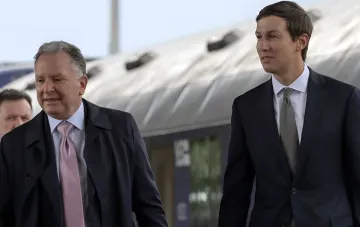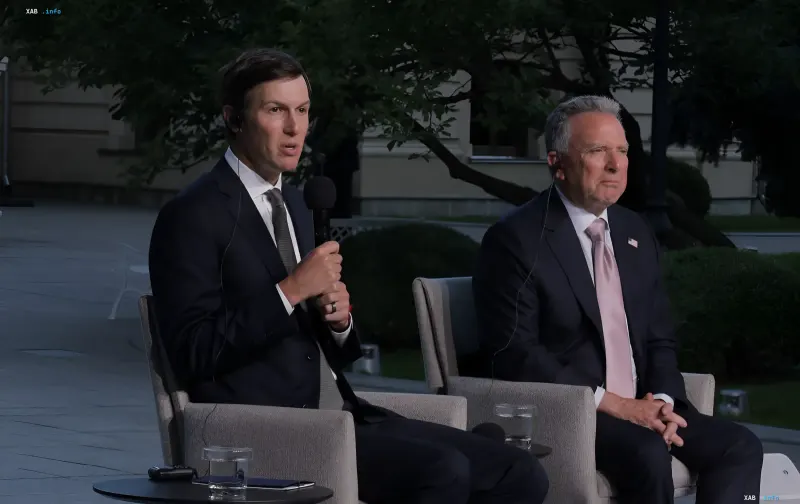
U.S. President's Special Envoy Jared Kushner stated at the annual YES forum in Kyiv that the American side has already prepared the main body of the agreement on ending the war in Ukraine. According to him, the key obstacle to signing the document remains Kyiv's unwillingness to accept Vladimir Putin's territorial demands. This is reported by RBC-Ukraine, citing "Ukrainska Pravda."
What Kushner said at the YES forum
Addressing the audience, the representative of the U.S. administration noted that Moscow has already defined the boundaries of the territories Russia is seeking, and that Washington has effectively "assembled" the rest of the agreement's text. "If Ukraine wanted to retreat to that line, we would already have the rest of the agreement assembled. But Ukraine does not want to do that now," Kushner stated. He added that, in his assessment, both Kyiv and Moscow are striving to end the conflict, and now a "right formula" that satisfies all parties to the process needs to be found.
The territorial issue and the front line
Kushner emphasized that the mediators' task is to find a solution that allows the conflict to be frozen, while the territorial issue, in his view, should be resolved taking into account the situation on the battlefield. The American side, he said, is trying to create conditions for a cessation of hostilities. Thus, Washington positions itself as the party that has already brought the negotiating document to the final stage and is awaiting Kyiv's decision on what he describes as the main, "narrow" issue — the line of withdrawal.
An energy truce and the winter scenario
A separate source told RBC-Ukraine that the outcome of Steve Witkoff's and Jared Kushner's work could be a winter energy truce between Ukraine and Russia. The main argument put forward by the American side was the fact that in previous winters the Russian Federation had failed to achieve its goal. Meanwhile, David Arakhamia, a member of the negotiating team, had earlier assessed that Russia could return to the negotiating process as early as the beginning of October, with the State Duma elections — which, in his words, are to be held in September — being an important factor in this.
Contradictory data
The parties' statements and assessments of the negotiating track contain discrepancies regarding the timing and format of a settlement. On the one hand, Kushner speaks of an "already assembled" main body of the agreement, with the territorial issue named as the sole obstacle; on the other — an RBC-Ukraine source describes a more modest and deferred outcome: a winter energy truce, rather than a full end to the war. Moreover, Arakhamia ties Moscow's possible return to negotiations to the beginning of October and the results of the September State Duma elections, which contradicts the claim that the document is ready to be signed "here and now." Finally, the very "line" to which, according to Kushner, Ukraine should retreat does not match in wording his own call to resolve the territorial issue "taking into account the situation on the battlefield," leaving room for various interpretations.
Context and significance of the statements
Kushner's speech at the YES forum confirms that U.S. diplomacy continues to push a "freezing" scenario for the conflict, emphasizing territorial concessions on Kyiv's part. For Kyiv, such statements mean pressure in favor of a compromise on Donbas; for Moscow — a signal that Washington is treating its territorial demands as the basic framework of the agreement. The outcome of Trump's emissaries' work, according to sources, could be a phased format: first a winter energy truce, then a broader negotiating round tied to Russia's domestic political calendar.