Kyiv continues to accept applications for participation in the 70/30 co-financing program, through which residential buildings receive city funds to strengthen their energy resilience. Mayor Vitali Klitschko announced this on October 27 via his Telegram channel, emphasizing that the program is a key element of the city's overall energy resilience plan. According to him, the plan includes not only large-scale projects to build backup power and heat supply systems and cogeneration plants, but also a targeted increase in the number of projects aimed at boosting the energy resilience of residential buildings.
What is the 70/30 Program
The mechanics of the 70/30 program are based on co-financing: the city or state program grants cover the major share of costs—about 70%—while the remaining 30% is paid by the homeowners' association (OSBB) or tenant community. This format allows even small residential communities to implement projects that would otherwise be unaffordable under full self-financing. Klitschko recalled that Kyiv operates five co-financing programs for residential buildings: the 70/30 program, a revolving fund, a capital repairs program, reimbursement for independent power sources, and financial assistance for newly created associations. Each of these covers a specific segment of needs—from replacing utility networks to installing generators and solar power plants.
Inspection of One of the Country's Largest Energy-Resilient Residential Complexes
During his visit, the Mayor of Kyiv personally inspected one of the largest energy-resilient residential complexes not only in the capital, but across all of Ukraine. The project involves an association on the city's left bank uniting three buildings with a total area exceeding 30,000 square meters. Klitschko called this object an example of a systematic approach to multi-apartment building management and the professional work of the association's board, which has consistently implemented projects under several municipal programs.
Technical Equipment: From Solar Panels to Generators
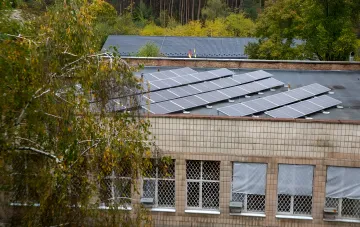
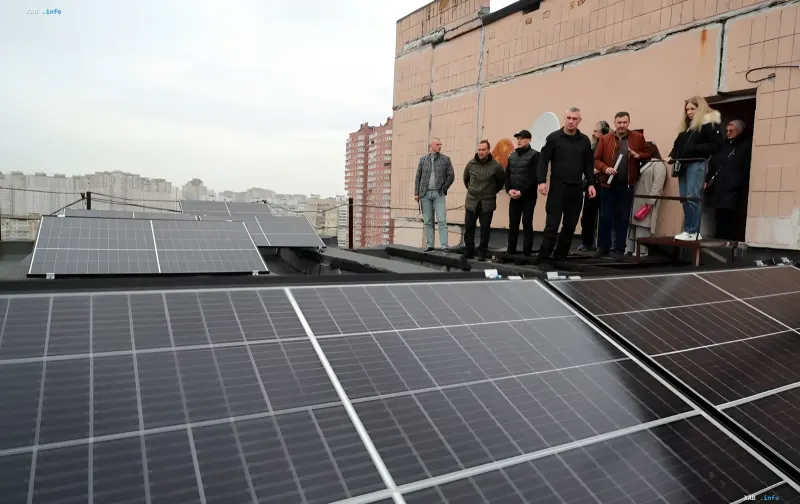
Under municipal programs, the complex received three individual heating substations (IHS) and additional equipment that evenly distributes heat among all apartments and provides at least 20% thermal energy savings. In addition, a 9 kW generator and one of the largest solar power plants for a residential building were installed on-site: three inverters, a 135 kW battery storage system, and 108 solar panels. This system ensures the operation of elevators, heating substations, control systems, and common area lighting for at least 15 consecutive hours during a centralized power outage. Photos published on the mayor's Telegram channel show rows of solar panels mounted on the building's roof, as well as a group of residents and association representatives accompanying the inspection.
Major Repairs, Elevators, and Facade Insulation Plans
In addition to energy equipment, windows and doors as well as six elevators were replaced in the building under municipal programs. Capital repairs of utility networks with insulation were carried out, and the lighting system was modernized with motion sensors to further reduce electricity consumption. Currently, the association's head is applying for facade insulation work and plans to obtain a loan from the revolving fund—another municipal support instrument. According to Klitschko's assessment, the combined effect of the implemented measures has allowed residents to effectively upgrade their homes, making them more energy-resilient, economical, and comfortable to live in.
Context: Why Home Energy Resilience Has Become a Priority
The 70/30 program and related initiatives are part of Kyiv's broader energy resilience plan, which was formed in response to systemic threats to energy supplies. Large-scale projects for backup power and heat supply and cogeneration systems are complemented by targeted solutions at the level of each individual residential building. This multi-level approach—from municipal infrastructure to an individual stairwell—is intended by the authorities to ensure the housing stock's resilience to prolonged electricity and heat outages. Applications for the 70/30 competition remain open, and city authorities urge homeowners' associations and united building councils to actively use available co-financing tools.