On the grounds of the Mykhailiv Golden-Domed Monastery in Kyiv, a museum-archaeological space called "The Gate Church and Kyiv of the 10th–13th Centuries" is now operational. The initiative, carried out by archaeologists, public organizations and volunteers, focuses on preserving and presenting the archaeological and architectural heritage of the Kievan Rus' era. The project has become a unique phenomenon in the capital's museum environment: with an estimated cost of 1–1.5 million UAH in 2025–2026, virtually no budgetary funds were spent on its realization.
Seven centuries of oblivion and the tragedy of the 1930s
The gate church of the Mykhailiv Golden-Domed Monastery was built in the 12th century and served as the main entrance to the monastery. According to many historians, it was destroyed during the invasion of Batu's troops and was never rebuilt. It was forgotten for more than seven centuries. In the 1930s, the Soviet occupiers destroyed the entire monastery complex, leaving only a few structures. As the author of the publication, Roman Malenkov, editor-in-chief and co-founder of the local-history portal "Ukraina Incognita," notes, had the planned construction been fully carried out at that time, there would have been neither a restored monastery nor the gate church itself.
Archaeological excavations of the late 1990s
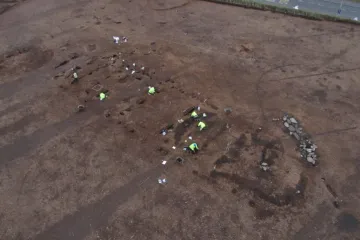
Systematic scientific research of the site where the gate church stood began before the restoration of the monastery complex in the late 1990s. Studying the cultural layer of the 10th–13th centuries, archaeologists discovered the foundations and remains of the walls of the gate church. Among the finds from that excavation were fragments of brick (plinfa), fragments of Kievan Rus' ceramics, household items, elements of metal ornamentation, and remains of construction mortar. The excavation results made it possible to clarify the boundaries of the 12th-century monastery territory, the construction technologies of that period, and the planning structure of the Upper City of Kyiv. However, the remains of the gate church were covered with a pavilion and virtually forgotten for a quarter of a century, without even being placed on the state register.
2025 museumization and the role of tolokas
Only in 2025, at the initiative of archaeologists, representatives of the "Ancient Kyiv" State Institute of Archaeology, and the public organizations "Ukraina Incognita" and "Smelyi Vistnovlyuvaty" ("The Brave Restore"), work began on the museumization of the remains of the gate church. In parallel, registration documentation was prepared, and today the site is officially an archaeological monument. An important component of the project's realization was public participation in the form of tolokas: volunteer clean-ups and site improvements were carried out with the involvement of specialist archaeologists, who instructed participants on the rules for working with the cultural layer. The toloka participants helped clear the site of construction debris, remove the soil with which the site had been conserved back in the 1990s, and prepare the area for the creation of a museum space.
Exhibition and further plans
The project was also helped by patrons, who provided gravel for the floor, as well as treated and painted the walls of the pavilion. Informational stands and banners are displayed on the walls. The work, however, is not yet complete: an exhibition of archaeological artefacts dedicated to that period is planned for the pavilion. A brick (plinfa) bearing the imprints of animal tracks and a human foot is already on display. Overall, the exhibition space will cover three main themes: the urban-planning structure of Kyiv in the 10th–13th centuries, the history of the construction and operation of the Mykhailiv Monastery, and the methodology of modern archaeological research.
Contradictory data
No significant contradictions in dates, figures, or versions of events were identified in the provided sources. The only caveat concerns the cause of the destruction of the gate church: the text states that it was destroyed "according to many historians" during the invasion of Batu's troops, which is formulated as the prevailing but not the only view in the scholarly community. All other facts — the dates of the excavations, the period of oblivion, the cost of the project, and the composition of the participants — are presented consistently and without discrepancies.