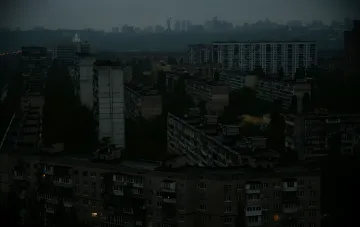
Following the massive shelling on November 3, 2026, which resulted in three thermal power plants ceasing electricity generation, Kyiv found itself in the most difficult electricity supply situation among all Ukrainian cities located outside the frontline zone. In an interview with RBC-Ukraine, Energy Research Center Director Oleksandr Kharchenko assessed the current state of the energy system as "challenging, but absolutely under control," while emphasizing that the capital's high-voltage networks are currently under the greatest pressure from Russian strikes.
Generation held up, but networks are under constant fire
According to Kharchenko, despite damage to three TPPs, the overall generation capacity of the energy system remains sufficient. "In terms of overall generation capacity, the situation is better than the situation with high-voltage networks, which, unfortunately, are suffering significantly right now and are under constant attack," the expert noted. It is the high-voltage mains managed by Ukrenergo, which transport electricity to Kyiv, that have become the primary target of Russian pressure. This means the problem is not a lack of generated electricity, but the inability to deliver it seamlessly to consumers in the capital.
The main challenge: repairs under drone fire
Kharchenko identified systematic attacks on repair crews as the key factor complicating restoration. "They are essentially blocking repair work by constantly keeping key high-voltage networks under attack... Crews simply cannot go out to work because drones are constantly hovering over the sites, circling demonstratively, and it is clear that no one will put people in harm's way," the expert explained. According to his assessment, air defense is the only tool capable of unblocking the repairs: if air defense secures the safety of repair crews between massive shellings, "Kyivans will feel a very substantial improvement in the situation in literally a week." At the same time, Kharchenko admits that it is impossible to stop ballistic missiles with existing means, but the drones creating a constant threat to personnel must be neutralized.
Worst-case scenario: four to twelve hours without power
When asked about the maximum restrictions, the expert admitted that in the worst-case scenario, Kyiv's power supply schedules could include periods of 4–6–8 hours per day, though he considers such an option unlikely. "Honestly, I don't think it will happen," Kharchenko stated. He explained the mechanism of how schedules are formed: after a strike and an emergency shutdown, priority repairs and the organization of backup power routes take 6–8 hours. After that, planned restrictions come into effect, which, according to the expert's assessment, "will not be worse than 12 hours of restrictions per day, even in the saddest variants." A complete disconnection of the capital from the integrated power system for a day and a half or more, in his opinion, is excluded.
Kyiv is not the only one, but it is the most vulnerable large city
Kharchenko clarified that the situation in the frontline zone is always objectively more difficult, and Kyiv has no "competitors" there. However, among cities in the rear, the capital is experiencing the greatest difficulties, which is explained by its scale: "Kyiv is larger, and that means more consumption, more challenges." The expert separately noted that the situation in Dnipro, Kryvyi Rih, Odesa, and Kharkiv is also difficult but does not reach the level of tension in the capital. Russia, according to Kharchenko, "has focused on this" — that is, it is purposefully limiting the flow of electricity to Kyiv, and this scenario was foreseen in advance during the preparation of the energy system for the off-season.
Risk of cascading failures: light, water, heat
At the end of the conversation, the journalist moved on to the question of a possible simultaneous failure in the supply of electricity, water, and heating. The source cuts off at this stage, but it follows from the context of the interview that Kharchenko views these systems as interconnected: restrictions on generation and transport capacities inevitably affect water pumping stations and boiler houses. The expert previously indicated that if high-voltage networks are restored within a week, restrictions will be reduced "every day," which indirectly lowers the probability of a prolonged simultaneous shutdown of all three utility systems.