Gas stations in the Kyiv region are introducing a fundamentally new level of protection for staff and customers: gas station workers will gain access to a special digital air-awareness system already used by the Ukrainian Armed Forces. This was announced on September 15 by Timur Tkachenko, head of the Kyiv Regional State Administration, in his Telegram channel, citing a decision by the Kyiv Regional Defense Council adopted under the coordination of the Kyiv Regional Military Administration (KRMA).
What the New System Entails
According to Tkachenko, the key difference between this innovation and the usual air raid alert lies in the volume and precision of the information provided. Designated staff members at gas stations will be able to receive, in real time, up-to-date data on the movement of hostile aerial targets — trajectories, directions, and the nature of the threat. This will allow them not merely to react to a general siren signal, but to assess the specific danger and make a prior decision on whether to continue or suspend gas station operations. “Our task is to provide economic entities with the maximum available tools so that they can see the danger earlier and respond to it in time,” Tkachenko emphasized.
Context: 16 Strikes on Gas Stations Since the Start of the Conflict
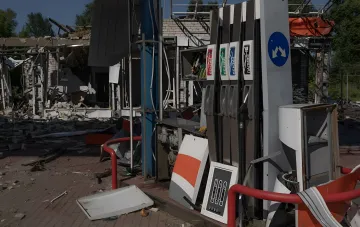
The decision to implement the system was taken against the backdrop of systematic attacks on fuel infrastructure. As of September 15, Russian forces had already attacked 16 gas stations in Kyiv. The morning of that same day was particularly tense: a drone struck a gas station in the Holosiivskyi district — this was already the second strike on a gas station within a single morning. Such intensity of attacks makes the issue of prompt staff notification critically important: a standard siren provides no information about where exactly a strike may occur or how close it is to a specific location.
Fuel Market Stability and an Appeal to Drivers
Despite the infrastructure damage, the Kyiv city administration (KMA) assured that no fuel shortage is expected in the capital and that the fuel market remains stable. Separately, Tkachenko addressed drivers, urging them to treat danger signals responsibly and to strictly follow the instructions of gas station staff during air raids. This means that, upon receiving data on a specific threat through the new system, staff will be entitled to suspend service, and customers are obligated to respect this.
Contradictory Data
No significant discrepancies in figures or facts were found in the provided sources. All four verified outlets (RBC-Ukraine, Sudoku, Gazeta.ua, Focus) confirm the fact that the Kyiv Regional Defense Council adopted the decision and the essence of the system. The only clarification: the base text refers to 16 attacked gas stations specifically in Kyiv (the city), whereas the system is being rolled out across the entire Kyiv region — the geographic scope of the innovation is broader than the damage statistics. This is not a contradiction but a difference in scale: the city is part of the region, and the decision applies to all gas stations in the region.
Broader: A Comprehensive Set of Measures to Protect Fuel Infrastructure
The implementation of the digital air-awareness system is not the only change. According to Focus, the KRMA also outlined additional steps to protect gas stations and staff, including procedures for clearing the premises of long-parked vehicles that may pose an additional danger in the event of a strike. Thus, the Kyiv region is forming a comprehensive safety protocol for gas stations that combines technological alerts, organizational measures, and a clear distribution of responsibility between staff and customers.