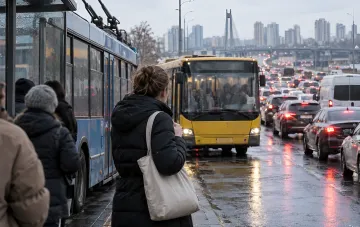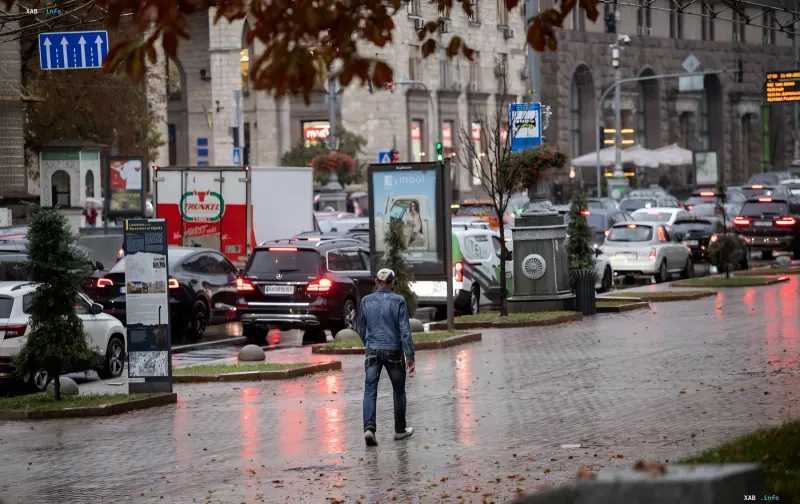
On the morning of November 5, Kyiv faced another difficult traffic situation, with the greatest congestion concentrated on approaches to bridges and key highways. As reported by RBC-Ukraine, during rush hour, a significant portion of drivers attempt to cross the city from the Left Bank to the Right Bank, and it is in these directions that the longest traffic jams form. Navigation maps record maximum delays on sections leading to bridges, and crossing the city along the "Osokorky – Maidan Nezalezhnosti" route is estimated by services at 430–850 UAH. In essence, morning Kyiv operates under high stress, when usual routes cease to be predictable.
The Southern Bridge and Traffic Redistribution
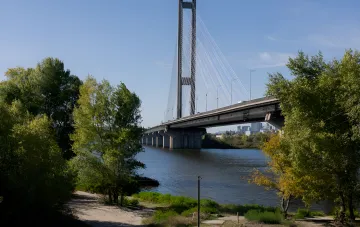
The key reason for the traffic complication remains the movement restrictions on the Southern Bridge, introduced following Russian attacks. Since one of the main bridges between the banks is effectively operating outside its normal capacity, traffic flow has redistributed to other bridges. This has led to increased load on them: where movement was relatively free before, dense congestion now forms. It is on the approaches to bridges and on connecting arteries that drivers lose the most time, and there are practically no alternative "fast" routes available during the morning rush.
No Electricity and No Traffic Lights
Additionally, local power outages further complicate movement in the capital. In several areas, traffic lights are not functioning due to power failures, turning regular intersections into points of risk and delay: drivers are forced to be extra cautious, traffic slows down, and delays accumulate. Thus, the traffic problem on November 5 has a dual nature — it is both a structural capacity limitation due to the Southern Bridge and an operational failure related to energy, which impacts real-time traffic management.
Buses Rerouted to the Darnytskyi Railway Bridge
Due to closures and traffic complications in Kyiv, routes for several buses have been adjusted. Specifically, lines No. 22ATD, No. 22TL, and No. 91D now follow the Darnytskyi Railway Bridge. This means that some passengers accustomed to previous trajectories are forced to transfer or adjust to the new route, while the Darnytskyi crossing experiences an additional load from public transport. For city residents, this is a practical hint: before traveling, it is worth checking current traffic patterns to avoid being late for work or school.
How Much Does It Cost to Cross the City
A separate aspect of the morning picture is the cost and time of crossing the city. According to navigation services, a trip from the Left Bank to the Right Bank city center, depending on the route and traffic, is estimated at approximately 430–850 UAH. A specific example is the "Osokorky – Maidan Nezalezhnosti" route, where the price spread reflects traffic instability: depending on the time and congestion, the journey can cost either the lower or upper limit of this range. For private drivers, this is also hours spent in traffic, not just money.
The summary of the morning of November 5 in Kyiv is a combination of several factors: restrictions on the Southern Bridge after attacks, flow redistribution to other crossings, power outages with non-functioning traffic lights, and bus route adjustments. All these elements together form a consistently difficult traffic environment, in which drivers and passengers are advised to set aside extra travel time and check current routes and restrictions in advance.