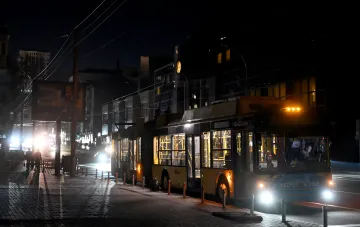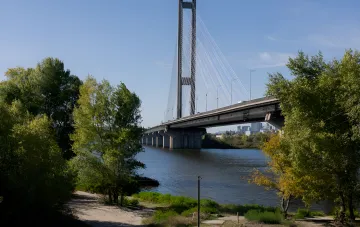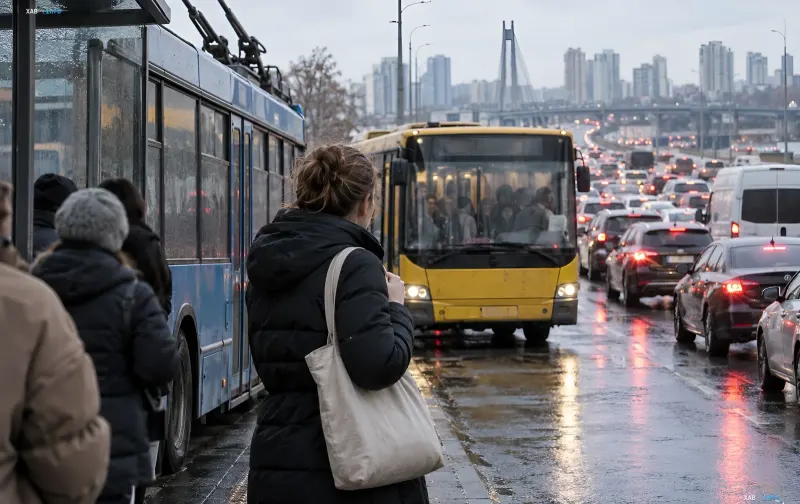
On Wednesday, November 4, 2026, Kyiv is experiencing one of its most tense transportation days in recent times. Car traffic along the capital's key arteries, especially heading from the left bank to the right, is significantly congested. According to Google Maps, the most serious delays are recorded on the approaches to the South Bridge, where drivers are forced to wait in multi-kilometer lines. The situation is exacerbated by the fact that since the evening of November 3, the operation of trams and trolleybuses has been temporarily suspended — according to city services, this is due to the critical state of Ukraine's energy system following enemy shelling. As a result, hundreds of thousands of passengers for whom electric transport is the main mode of travel found themselves forced to seek alternatives under conditions where already overloaded roads cannot cope with the increased flow.
The Cause: Suspension of Trams and Trolleybuses
The decision to temporarily suspend electric transport operations was made in the evening hours of November 3 against the backdrop of critical strain on the city's energy system. As Kyiv Mayor Vitali Klitschko reported, the electricity situation in the capital remains very difficult, and warming stations are being deployed across the city for residents. The suspension of trams and trolleybuses became a forced measure aimed at preserving the operability of the remaining sections of the power grid. According to promises by city authorities, the resumption of electric transport operations will take place immediately after the energy system stabilizes. Specific timelines for restoring the routes were not announced at the time of publication.
Temporary Buses and Overcrowded Minibuses
To ensure minimal connectivity between the suspended sections of tram lines, city carriers launched temporary bus routes. In particular, in the area of the Poznyakoly, Osokorky, and Kharkivska metro stations, buses No. 27T and No. 22T are running instead of the usual trams. However, these alternative routes operate under the same conditions as the rest of surface transport: due to general traffic jams, buses are delayed on their routes, and the fixed-route minibuses that passengers transfer to are overcrowded. According to eyewitnesses, waiting times at stops reach half an hour, and some passengers, unwilling to waste time, prefer to walk to their desired destination.
Traffic Jams on Bridges and Key Directions
The most acute situation is developing on the approaches to the South Bridge — one of the two main road crossings over the Dnipro River within the city limits. According to navigation services, delays in this section are among the largest in Kyiv. Traffic toward the right bank is practically paralyzed: drivers are standing in long lines which, according to social media reports, do not decrease for several hours. Similar difficulties are observed on other key left-bank thoroughfares, making crossing the city by personal car extremely time-consuming. According to experts, the road situation will remain tense until electric transport operations resume and the load on highways decreases.
Taxis: Increased Demand and Rising Fares
Against the backdrop of a mass transition of passengers from stopped electric transport to taxis and minibuses, demand for rides has increased sharply. The most noticeable price increases are recorded on routes from the left bank to the right — in particular, on the Osokorky — Independence Square route. Taxi drivers, taking advantage of high demand, have significantly raised their tariffs. Specific figures depend on the app and current demand, but according to RBC-Ukraine, the cost of a trip along the specified route is several times higher than the usual level. For passengers who do not own a personal car and cannot wait for public transport, this becomes an additional financial burden in an already difficult situation.
When Normal Traffic Will Return
City authorities emphasize that the suspension of electric transport is a temporary measure. The resumption of tram and trolleybus traffic is scheduled for the moment the energy system stabilizes — that is, immediately after utility services can guarantee a safe power supply to the contact networks. While there is no exact restoration schedule yet, Kyiv residents are advised to plan routes with extra time, use the metro and pedestrian crossings where possible, and take into account when crossing the Dnipro that the South Bridge remains the most congested direction. The situation on the roads and in the energy system continues to evolve, and city services promise to keep residents informed of any changes.