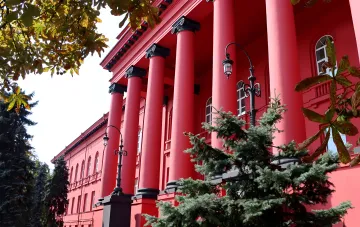
Following massive Russian strikes on Kyiv, a number of the capital's universities have promptly reconsidered the format of their educational process. Some institutions have temporarily intensified their remote mode, while others have kept a hybrid model, placing the safety of students and faculty first. RBC-Ukraine has gathered the official positions of several Kyiv universities, and their approaches differ markedly: from a full switch to online to targeted adjustments to timetables at the faculty level.
KNUSA intensifies online mode but keeps the air-raid rule
From 24 September, the Kyiv National University of Construction and Architecture (KNUSA) has temporarily intensified its online format: classes are held according to the timetable using remote services. The university emphasised that the rule for actions during an air-raid alert remains unchanged — after the siren, the class is suspended, and students and faculty immediately go to shelter and stay there until the all-clear. The university stated that it reacts to any information about a faculty member failing to comply with this rule and that "punishing students for absence from a class during an alert is unacceptable." The decision on the proportion of in-person and remote components is made collectively — together with deans, faculty members and the Student Self-Government Council — and is reviewed promptly depending on how events develop.
KNUTD moves to remote format until the situation stabilises
The Kyiv National University of Technology and Design (KNUTD) announced a switch to a remote format "in connection with the deterioration of the security situation and in order to preserve the life and health of all participants in the educational process." The university acknowledged that in-person learning is essential for technological, engineering and design specialisations, since the programmes include practical, laboratory, project-based and creative classes. At the same time, the university has underground shelters capable of accommodating everyone. Notably, after three weeks of remote learning, the university returned to offline mode on 21 September, but just two days later it changed the format again and promised to review it promptly if the situation changes significantly.
KTU and Kyiv Aviation Institute keep a hybrid model with an emphasis on offline
At the National Technical University "Igor Sikorsky Kyiv Polytechnic Institute" (KTU), a hybrid form of learning with an emphasis on in-person classes is planned for the 2026/2027 academic year. Rector Anatoly Melnychenko explained that during September adjustments were made to the timetable in line with the security situation, and the format is reviewed at the faculty level for prompt decision-making. Offline learning is primarily for students of technical faculties with a practical component; shelters are available both in the teaching buildings and in the dormitories. The Kyiv Aviation Institute (KAI) also operates a hybrid format: at three faculties, first-year students study in person, with their classes held in shelters, while at the other faculties the model is shaped taking into account the situation and infrastructure capabilities.
Contradictory data
Fact-checking revealed a discrepancy in the dates and reasons for the switch to remote learning. The main RBC-Ukraine material links the change of format to the massive attacks and dates the adjustments to September 2026 (specifically, it mentions the 23 September strike and the intensification of the online regime from 24 September). At the same time, a number of other sources (life.ru, gazeta.ru, ukranews.com) describe the switch of Kyiv universities and vocational-technical institutions to remote learning as a reaction to a blackout and date these reports to January 2026. Thus, in the public sphere two different episodes are being mixed up — the January blackout and the September attacks — with decisions that are similar in wording but different in cause and chronology. The article sets out facts relating specifically to the September situation after the attacks, in accordance with the primary RBC-Ukraine material.