Latvia is preparing legislative changes that will completely halt international passenger bus services to Russia and Belarus starting next year, in 2027. This is reported by RBC-Ukraine, citing the Latvian news agency Delfi. The ban, as intended by the ministry, is to cover not only direct routes but also transit routes through Latvian territory to both countries.
What the Ministry of Transport is preparing
The ministry has prepared not only a draft of the amendments but also an informational report on the further organization of international road transport to Russia and the improvement of regulatory oversight. The document analyzes the exchange of road transport permits between Latvia and Russia over 2022–2026, its impact on the economy and employment, and the state of passenger transport. The report is to determine the need for further legislative amendments and will be submitted for government review.
The only regular route and its fate
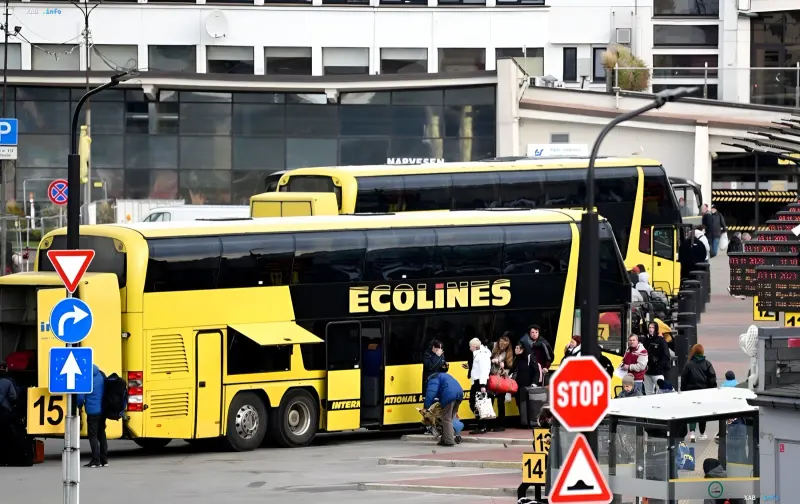
Under the current international agreement, only one regular bus route operates from Latvia to Russia. Daily services to Moscow are operated by the company Norma-A under the Ecolines brand — these are the yellow double-decker buses standing on the platforms of the Riga bus station. The permit for this route is valid until 9 January 2027, and the Ministry of Transport has stated that it does not plan to extend it.
Restrictions are already in force and will be extended
In parallel, the ministry is preparing an order to extend by another year the ban on irregular passenger transport to Russia and Belarus. Earlier, the Latvian government supported the initiative to introduce such a ban from 1 November 2025 to 31 October 2026 — meaning that as of now, in September 2026, it is already in effect.
Why the ban will not be total
The Ministry of Transport itself acknowledges that restricting regular services will not produce a complete effect. Passengers will be able to use connecting routes through Estonia and Lithuania, as well as minibus services, which are not covered by the rules governing bus transport. Therefore, the ministry intends to continue assessing the security, economic, and international-legal aspects in order to develop a coordinated decision at the level of the Baltic states and the European Union.
Context: trade restrictions and security rhetoric
The decision to end bus transport fits into a broader policy. From 1 September, Latvia has introduced a wide-ranging ban on the import of a broad list of industrial goods from Russia and Belarus, covering both direct imports and supplies through third countries; the country has also begun publishing lists of companies trading with the Russian Federation and Belarus that were previously kept confidential. The National Union of Latvia is in favor of a complete halt to passenger transport with Russia and calls for not extending the licenses of regular-route carriers. According to the party, in the first half of 2026 the Riga–Moscow route was used by 9,079 passengers, and demand in June grew by more than a quarter compared to January. Latvian President Edgars Rinkēvičs, for his part, reminds that "hostile operations are taking place already today," not in some distant future.