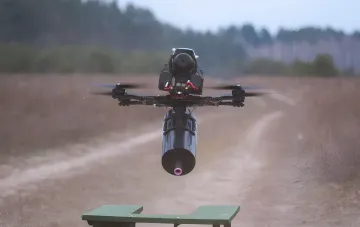
Italian state-controlled defense conglomerate Leonardo is deepening its presence in Ukraine through a newly created Kyiv-based unit, Leonardo Ukraine, which is 100% owned by Leonardo International and has a share capital of over 100,000 euros. The company, which was only publicly announced last month, will engage in scientific and engineering development in the defense sector. According to Leonardo CEO Lorenzo Mariani, who took the helm of the conglomerate earlier in 2026, Ukraine's small and medium enterprise and startup sector has demonstrated a high degree of ingenuity in creating innovative, battle-tested solutions, and gathering these developments on the ground is, in his view, "the right way forward."
The Michelangelo System and Trials in Ukraine
The key practical step in the cooperation will be involving the Kyiv unit in developing the Michelangelo air and missile defense system. The system's first component — the anti-drone one — is already being tested in Italy, while in Ukraine, according to Mariani, the artillery level of protection will be deployed first; the first trial in Ukraine is planned by the end of 2026. The system is already being offered to export customers in need of protection against drone and ballistic threats, with Leonardo focusing primarily on existing customers who use its sensors, as they are better positioned to assess the benefits of integrating these sensors into a broader defense architecture.
Contradictory Data
In public statements by Leonardo's leadership on the Michelangelo issue, a difference in emphasis can be traced, linked to the change in CEO. The company's previous head, Roberto Cingolani, whose words were earlier reported by RBC-Ukraine, stated that the first component of the "dome" is being built specifically for Ukrainian partners and that the results of its use at the front should confirm the effectiveness of the approach. The current head, Lorenzo Mariani, in turn, describes a more staged scheme: the anti-drone component is being tested in Italy, the artillery level is deployed first in Ukraine, and a full trial of the system on Ukrainian territory is expected by the end of the year. The two versions do not contradict each other in substance, but they differ on which specific element of the system and in what sequence is brought to the Ukrainian segment, which is important to consider when interpreting the timing and scale of the trials.
European Defense Potential Strategy
Leonardo's approach fits into Mariani's broader strategy of building European defense potential through partnerships and industrial consortia against the backdrop of a weakening transatlantic alliance. The conglomerate's head, who previously led MBDA, asserts that Europe is capable of creating systems comparable to American ones when countries pool resources and coordinate procurement, citing as an example the latest SAMP/T missile defense system from the Eurosam joint venture (MBDA and Thales), which he called no less effective than the American Patriot. Similar logic has already been applied by Leonardo in partnerships with Germany's Rheinmetall in the field of ground systems and with Turkey's Baykar in the field of drones; Mariani added that the company remains open to new alliances where they can accelerate investment or compensate for capabilities that European industry has not developed on its own.
The Bromo Space Project as a Test of European Integration
Beyond defense programs, Mariani outlined the timeline for the Bromo space project, which Leonardo is developing jointly with Airbus and Thales. According to him, the approval process is progressing well: the structure is designed for a full launch on January 1, 2028, and if the procedural stages are completed quickly, work could begin as early as mid-2027. The Bromo project, currently undergoing European regulatory review, is seen as a test of Europe's ability to create industrial champions by combining the capabilities of different countries: it is meant to give Europe greater scale in the space industry and help narrow the technological gap with the United States in satellite communications against the backdrop of SpaceX's growing dominance.