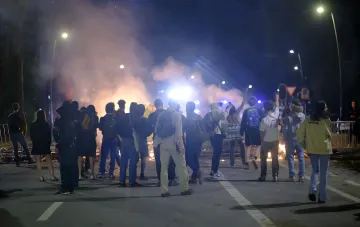
On November 15, 2026, the Letná Plain in Prague — a vast open space on a hill above the historic city center — could not hold everyone who came to the protest. Demonstrators spilled over into the adjacent park, and according to the organizers' estimates, between 350,000 and 450,000 people gathered for the "Letná vs. 4:36" rally. If these figures are confirmed, the Czech Republic has not seen such massive street demonstrations since the 1989 Velvet Revolution, which put an end to the communist regime in Czechoslovakia. Placards displayed logos of Czech Television and Czech Radio, hearts, and slogans defending media freedom, while some participants wore paper caps of Večerníček, the children's television character familiar to several generations of Czechs.
From a Technical Question to a Nationwide Conflict
The catalyst for the protest was a government bill proposing to abolish special household fees for public television and radio and transition these structures to state budget funding. At first glance, this looked like a technical change in the payment mechanism. However, demonstrators fear that the new system will threaten the independence of broadcasters: when money comes from the treasury rather than directly from citizens, the government gains an additional lever of influence over editorial policy. The protesters' demands also extended more broadly — they opposed the methods by which the ruling coalition pushed through the reform without adequate public dialogue.
How Public Broadcasting Works in the Czech Republic
Two public media organizations operate in the Czech Republic: Czech Television (Česká televize, ČT) and Czech Radio (Český rozhlas, ČRo), established under special laws. They are mandated to provide society with independent information, educational, cultural, children's, and entertainment programs. The fundamental difference between a public broadcaster and a state television channel is that the former must serve citizens regardless of which party is in power. Directors-general are appointed by special councils rather than ministers, creating an institutional distance between editorial offices and the incumbent government. Financing plays a key role in maintaining this distance: Czech households pay 150 crowns per month for television and 55 crowns for radio. A total of 205 crowns, or approximately eight euros, goes directly to public broadcasters without passing through the state budget.
The Government's Position and Arguments from Both Sides
The current Czech government is led by billionaire Andrej Babiš, founder of the populist ANO movement ("Action of Dissatisfied Citizens"). Following the 2025 parliamentary elections, ANO formed a coalition with two right-wing parties — the nationalist Freedom and Direct Democracy (SPD) of Tomio Okamura and the Motoristé sobě (Motorists for Themselves) party, which opposes excessive state regulation. The government relies on an argument that genuinely resonates with many citizens: it is unfair to pay for television you do not watch, and a flat fee for households with different incomes raises legitimate questions. However, supporters of the current model emphasize that society funds an institution rather than a specific service — similar to how it pays for the existence of libraries or other public institutions, even if an individual does not use them.
Who is Organizing the Protest and Why It Is Not a "Party Rally"
The demonstration was organized by the civic movement "Million Moments for Democracy" (Milion chvilek pro demokracii), known for massive protests against Andrej Babiš during his previous tenure as prime minister. This is not a political party, but a civic organization dedicated to mobilizing citizens to defend democratic institutions. The very fact that the protest is cross-party and civic in nature amplifies its message: it is not about supporting a specific opposition force, but about defending a principle that participants believe affects everyone — including those who do not like Czech Television or Czech Radio. The willingness to defend even unliked media from political control has become, in essence, a marker of civil society's maturity.
What's Next
The bill on transitioning public broadcasting to budgetary funding remains under parliamentary review. The massive turnout on November 15 — the largest in 37 years — creates unprecedented public pressure on the ruling coalition. Whether the government will back down, introduce amendments, or insist on the original wording will become clear in the coming weeks. One thing is already certain: an issue that began as a discussion about 205 crowns a month has turned into one of the Czech Republic's main social conflicts and a test of the strength of the country's democratic institutions.