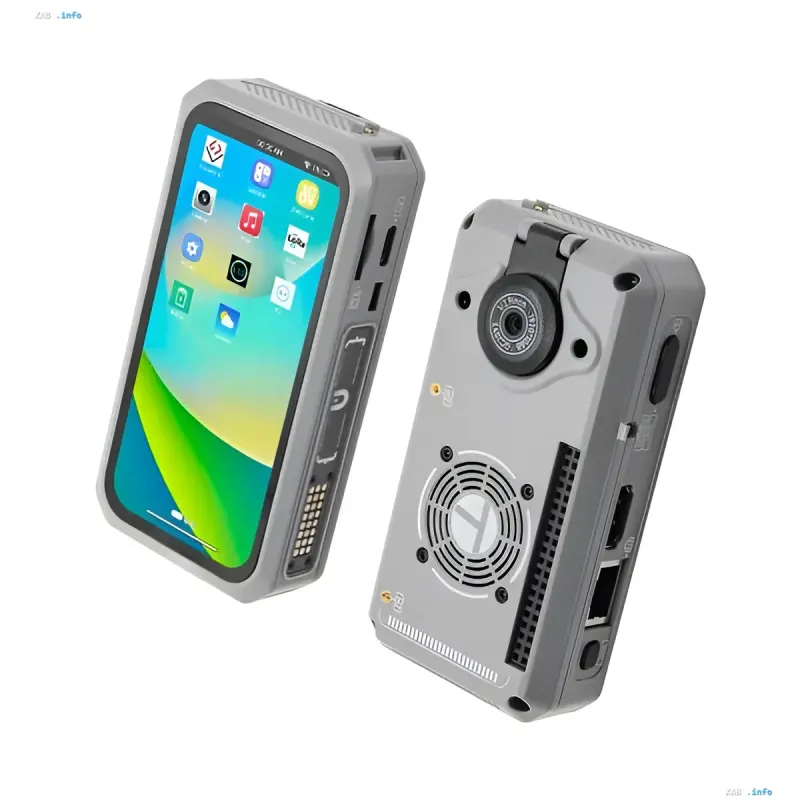
LilyGo has unveiled the K230 CoreSet — a ready-made, "enclosed in a case" version of its development platform that looks like a compact smartphone but is essentially a portable engineering station. The device is aimed at developers, engineers, and electronics enthusiasts who need a portable test bench for experimenting with embedded systems and computer vision, rather than a consumer phone. The base configuration is priced at around 150 dollars, and the manufacturer offers a compact keyboard as an optional accessory.
Hardware: RISC-V core and ESP32 coprocessor
At the heart of the K230 CoreSet is the Kendryte K230 processor with a RISC-V architecture and hardware acceleration for 3D graphics — this is the key difference from typical ARM solutions and a direct entry point into the open-instruction ecosystem. The main chip is paired with an ESP32-S3-R8 microcontroller, which handles sensor and external peripheral connections. This two-tier design lets you split heavy compute and graphics processing on the K230 from lightweight interface management on the ESP32, which is convenient for prototyping complex devices.
Display, camera, and a rich set of ports
The device features a 4.1-inch AMOLED display with a resolution of 568 × 1232 pixels, delivering a dense, high-contrast image in a pocket form factor. A 2-megapixel camera is built into the case, and additional camera modules can be connected via the MIPI CSI interface — for example, for computer vision and machine learning experiments. The port selection is unusually complete for its class: two USB ports, HDMI, Ethernet, a 3.5 mm audio jack, and a microSD card slot, eliminating the need for external adapters when working at a test bench.
Connectivity: Wi-Fi and LoRa instead of LTE and 5G
It is important to understand the device's positioning: there is no 4G or 5G support, and this is a deliberate choice rather than a limitation. Wireless connectivity is limited to Wi-Fi and the LoRa protocol, designed for transmitting small amounts of data over long distances — reportedly tens of kilometers. This makes the K230 CoreSet suitable for scenarios where telemetry range and energy efficiency matter more than mobile internet throughput.
Price, audience, and market position
At a starting price of around 150 dollars and an optional keyboard, the K230 CoreSet occupies the niche between a regular SBC and a full-fledged industrial controller: it is a "ready-to-work" enclosure that saves time on assembly and lets you start developing right away. For engineers and hobbyists, it is a way to quickly validate an idea on RISC-V hardware with graphics acceleration and flexible peripherals, without building a custom board.