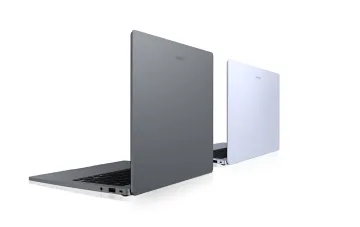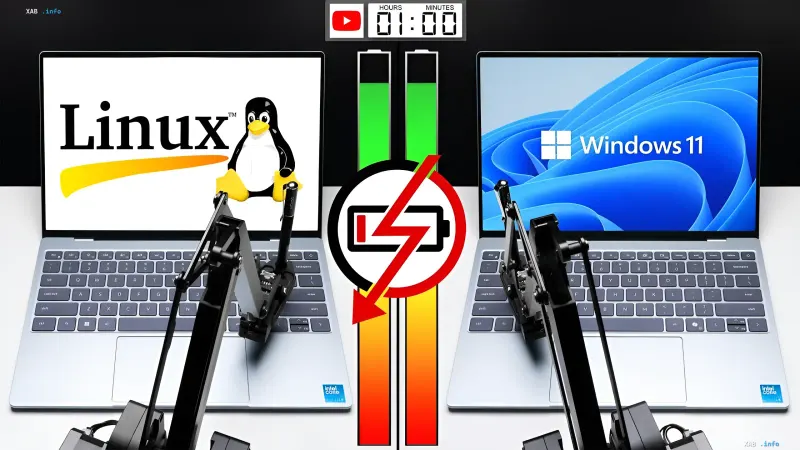
Popular tech channel PhoneBuff, known for detailed comparisons of current iPhones, has now shifted its focus to portable computers and tackled a question laptop owners have long wondered about: how much real-world battery life actually differs on the exact same machine running different operating systems. For the experiment, the authors chose the recent Dell XPS 13 model powered by the Intel Core 5 320 processor, which Intel specifically positions for energy efficiency. On one side, Windows 11 was installed on the device; on the other, the Linux Fedora distribution. Thus, the hardware remained identical, with the software environment being the sole variable.
Methodology and General Test Progress
Within a comprehensive workflow scenario, both laptops ran the same sequence of tasks, and for most of the test, their battery performance ran almost neck-and-neck—the gap was negligible and did not allow for definitive conclusions. The turning point came in the final stage when the Minecraft game was introduced. This placed a notably higher load on the chip than all previous stages, and it was precisely here that the systems had to demonstrate true power management efficiency under peak demand.
What Happened in the Final Stage
Running Windows 11, the laptop lost its final 25% of battery and completely shut down within 45 minutes of gaming. Over the same timeframe, the Linux version dropped from 27% to 13%—a noticeable decrease, but without a critical outcome. However, the authors honestly note that even those 13% would not have lasted long under the same load, meaning the general test did not become a definitive argument in favor of either system.
Isolated Minecraft Test
To remove the influence of previous stages, PhoneBuff ran a separate comparison exclusively in Minecraft, and here the difference was vividly apparent. By the time the Windows 11 laptop completely ran out of battery, the Linux version still had 46% charge remaining. Total runtime reached 3 hours 41 minutes for Windows 11 versus 6 hours 31 minutes for Linux Fedora—nearly a twofold advantage.
Additional Check in VS Code
To confirm the stability of the result, the authors ran another scenario—coding in the VS Code editor, simulating typical productivity workloads. Here, Linux's advantage persisted, though slightly less pronounced: 5 hours 50 minutes compared to 3 hours 44 minutes for Windows 11. The combination of the two isolated tests points to a systematic, rather than random, difference in energy efficiency between the two systems on identical hardware.
What This Means in Practice
PhoneBuff's results confirm a trend long discussed in the community: with the same processor and battery, the choice of operating system can alter real-world battery life by hours. For users who value mobility and work far from an outlet, switching to a load-optimized Linux distribution may prove to be a practical rather than ideological solution. It is important to note that the test was performed on a specific model and specific scenario, so absolute figures do not translate one-to-one to other configurations.