The world of wearable electronics is on the verge of a revolution. Instead of bulky bracelets and rigid patches, scientists have developed a technology that turns human skin into a functional surface for collecting medical data. The new invention is a conductive paint capable of functioning as a reliable biometric sensor.
Chemistry that stretches with the skin
A study published in the prestigious journal Proceedings of the National Academy of Sciences (PNAS) describes the creation of a unique composition. To obtain a material that would be simultaneously flexible, sticky, and safe for the epidermis, researchers combined several complex chemical components.
The polymer mixture PEDOT:PSS plays a key role in ensuring conductivity. A special acid, DBSA, acts as a plasticizer responsible for elasticity. It is precisely this component that allows the dried drawing on the skin to stretch in sync with human movements without losing contact. The solution base consists of water, ethanol, and polyvinyl alcohol, which gave the invention the acronym WE-PPD.
Tests for strength and accuracy
The elasticity of the new material is impressive: it can withstand stretching up to 170 percent without tearing. This is critical for wearable devices that should not limit the user's mobility.
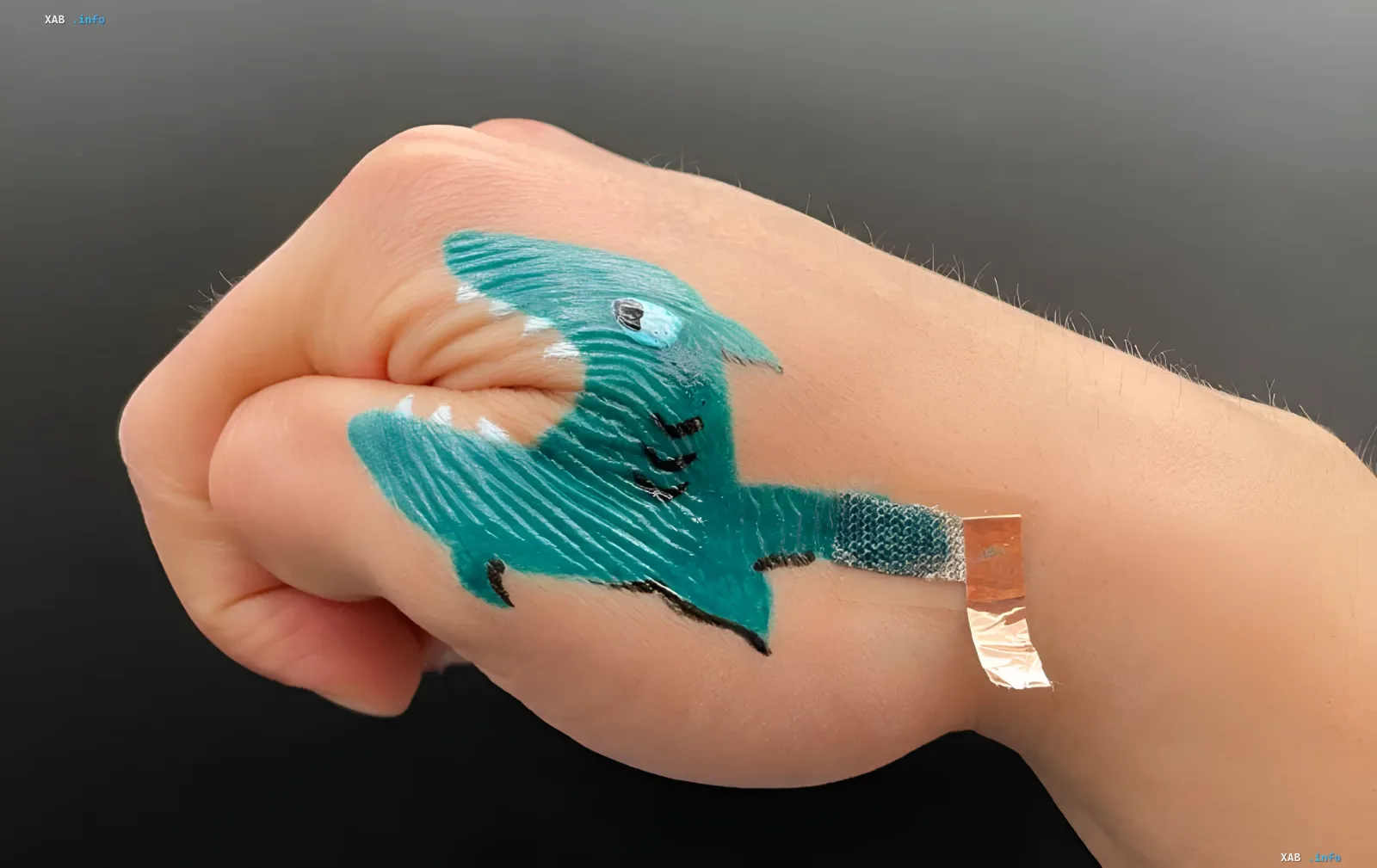
During practical trials on treadmills, the sensors demonstrated high reliability. Even with profuse sweating, the accuracy of the ECG recording was 95.1 percent. To transmit signals to monitors, the liquid system is connected to a thin elastic silver fabric.
Breathing skin and safety
One of the main problems with classic medical sensors is the disruption of skin thermoregulation. The new solution significantly outperforms standard analogues, such as Tegaderm film, in terms of air permeability:
- At a temperature of 22 degrees Celsius, the paint passes 5 times more moisture.
- In hot conditions (37 degrees Celsius), this figure increases 10 times.
The safety of the material was also confirmed during tests on volunteers. Continuous wear of the applied electronics for 24 hours did not cause any toxic reactions or irritation.
From sports to pediatrics
The prospects for applying the technology go far beyond the creation of sports trackers. Scientists see huge potential in pediatrics. Long-term monitoring of heart or brain function often becomes a stress factor for young patients due to complex equipment. The new polymer allows biosensors to be applied in the form of bright pictures, which reduces children's anxiety and improves the social perception of their condition during treatment.
The main challenge before implementation
Despite successful initial trials, the path to mass implementation of the technology still lies ahead. The main obstacle remains the certification of the mixture for use in magnetic resonance imaging (MRI).
Scientists need to study in detail the behavior of the paint under the influence of radiofrequency heating and electromagnetic pulses of MRI scanners. This is necessary to guarantee the absence of a risk of accidental skin burns in patients during diagnostic procedures.