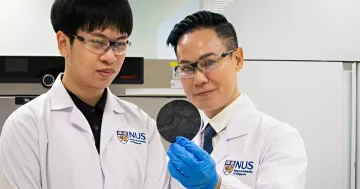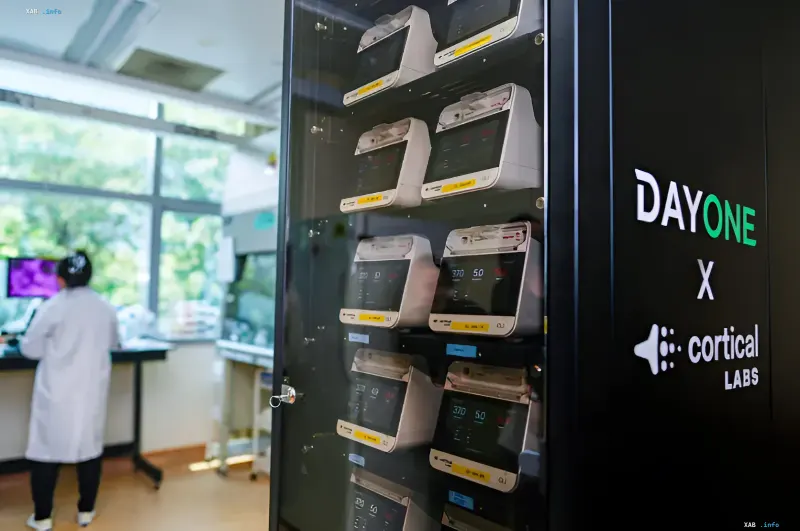
DayOne, together with Australian startup Cortical Labs and the medical faculty of the National University of Singapore (NUS Medicine), has put into operation the country's first prototype of a 'biological' data center, reports DataCenter Dynamics. The Singaporean biological computing system consists of 20 CL1 blocks and is located in an active research environment at NUS Medicine, provided by DayOne. The launch is a logical continuation of a previously reached agreement between the parties to create biological computing data centers in Melbourne and Singapore.
How the CL1 Platform Works and What SBI Is
The CL1 system, presented in 2025, combines neurons grown from human stem cells with silicon solutions. According to the company, the project's goal is to create a 'more advanced and environmentally sustainable form of AI,' which the developers call Synthetic Biological Intelligence (SBI) neural network. The platform feeds neurons information about their surrounding virtual environment, and the neurons react to the incoming data by generating impulses that affect events in the simulation. The integrated system keeps the neurons alive for up to six months, providing a stable working environment for experiments.
From DishBrain to Commercial Bio-Computers
CL1 is an upgraded version of Cortical Labs' DishBrain bio-computer, which used a CMOS chip with 800,000 human and mouse neurons and independently learned to play Pong — a 1972 computer game that simulated table tennis matches. According to a Cortical Labs representative, the creation of the new prototype moves biological computing into the realm of commercial application. Developers claim that such systems can complement classical AI in areas where there is not enough data for conventional artificial intelligence, since 'biological' AI is capable of learning from significantly smaller volumes of information and adapting as conditions change.
Gaming History: From Pong to DOOM
Public materials on Cortical Labs' projects feature different gaming scenarios: Pong is mentioned for the original DishBrain, while later reports and reviews (including on ixbt.com) talk about running DOOM on human brain cells. This is not a contradiction but a reflection of the platform's evolution: from the simplest arcade to more complex gaming environments that require more sophisticated adaptation from the neural tissue. Nevertheless, the exact number of neurons in the new CL1 block is not disclosed in open sources, creating an information gap between generations of systems.
Investors and DayOne's Scale
Cortical Labs, founded in Melbourne in 2019, has already raised $11 million in funding. Among the investors are Horizons Ventures, Blackbird Ventures, LifeX Ventures, Radar Ventures, and the CIA-linked In-Q-Tel. Singaporean data center operator DayOne (formerly GDS International) has a data center portfolio with a total capacity of over 500 MW and is preparing for an IPO. In June 2026, the company raised $4.5 billion in funding, underscoring its strategic bet on new forms of computing infrastructure.
Contradictory Data
Open sources contain minor discrepancies in the details. First, different materials mention different gaming tests (Pong for DishBrain and DOOM for later Cortical Labs experiments), which may mislead readers about a single system. Second, the original DishBrain bio-computer is precisely stated to have 800,000 neurons, whereas for the new CL1 block the specific number of neurons is not provided in the available sources. Third, the base figure is Cortical Labs' $11 million raise, while in some reviews the total funding estimates for the startup may vary depending on how different rounds are counted. These discrepancies do not change the main fact — the launch of the prototype in Singapore — but they require caution when citing exact figures.