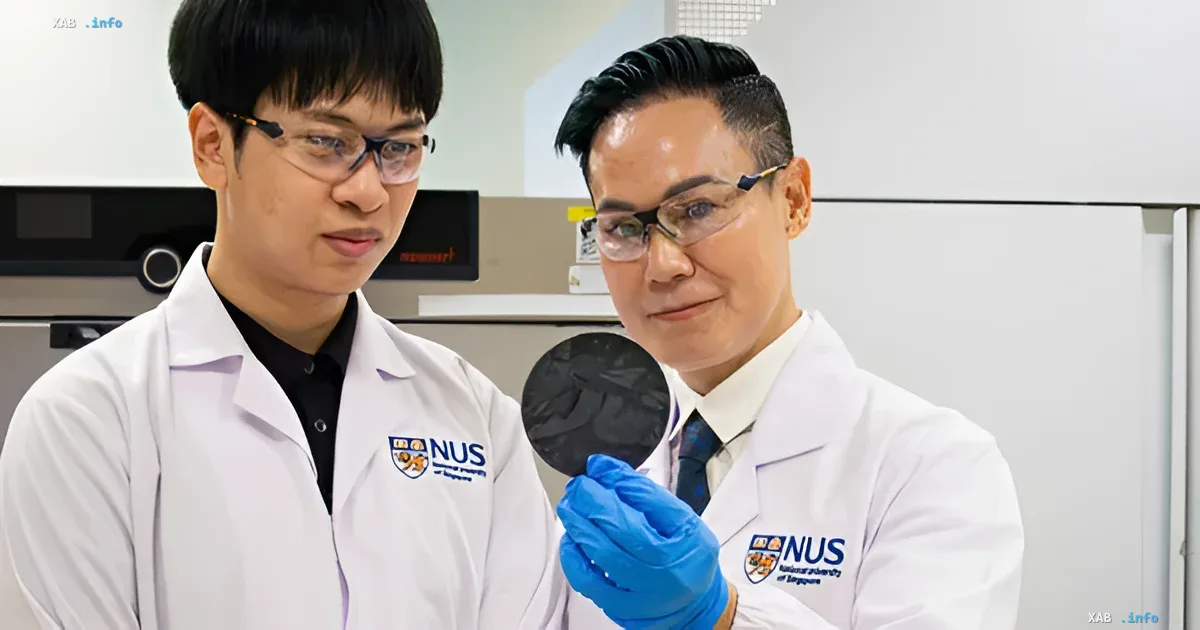
A team of researchers at the National University of Singapore (NUS) has developed a method for recycling hard-to-dispose composite waste — mixtures of carbon fibre and epoxy resin — into a lightweight, porous aerogel with a wide range of practical applications. The work was carried out by graduate student Phan Ngo Minh Quang under the supervision of Associate Professor Dr. Duong Minh Hai from the Department of Mechanical Engineering at the NUS School of Design and Engineering, with the participation of researchers from Singapore, Vietnam, and China. The results were published on 29 June in the peer-reviewed scientific journal Waste Management. In the photo from the NUS laboratory, the researchers are showing off a finished sample of the aerogel — a dark, round disc held in a glove.
A problem that grows every year
Carbon fibre and epoxy resin composites have become the standard in the aerospace industry, wind turbine manufacturing, and modern automotive and shipbuilding — anywhere that a combination of high strength and minimal weight is critical. However, at the end of their service life, these structures reach a dead end: unlike thermoplastic resins, epoxy resin, once cured, is virtually impossible to remelt and re-form. Existing technologies mainly extract the valuable carbon fibre, while the epoxy matrix is destroyed, sent to landfills, or used to produce low-value products. Alternative methods — pyrolytic, chemical, or thermal — require extreme temperatures, aggressive reagents, or large energy inputs, making them economically and environmentally questionable on an industrial recycling scale.
The “whole thing” approach: from powder to aerogel
Associate Professor Dr. Duong Minh Hai’s research group consciously rejected the strategy of separating the components. Instead of extracting the fibres and discarding the resin, the team proposed using the composite in its entirety. The waste is ground into a fine powder and short fibrous fragments, which are then mixed with carboxymethyl cellulose — a cellulose-based binder. The resulting suspension is subjected to lyophilization (freeze-drying under vacuum), which forms an aerogel: an ultra-light, highly porous material in which, according to the publication, 91–94% of the volume is made up of air-filled voids. It is precisely this structure that determines the key functional properties of the finished product.
Three application areas and safety testing
Testing showed that the aerogel has pronounced thermal insulation and sound-absorbing properties, opening the way to its use in building and engineering structures to reduce heat transfer and noise pollution. A separate block of experiments focused on sorption properties: after surface treatment to limit water permeability, the material absorbed a significant amount of oil while exhibiting extremely low water absorption. This property makes the aerogel potentially suitable for oil spill cleanup and the separation of oil emulsions. Cytotoxicity tests on fibroblast cells revealed no toxic effect of the material under experimental conditions, which, in the authors’ assessment, allows safety assessment in contact with humans and the environment to continue.
Scaling up and searching for partners
“Advanced composite materials have made it possible to create lighter and more efficient structures in many industrial sectors. The next step is to ensure the sustainable use of these materials at the end of their life cycle,” emphasized Associate Professor Dr. Duong Minh Hai. The group is currently actively seeking partners in the aerospace industry, advanced materials, manufacturing, and waste management. The priority tasks for the near term are scaling up the technology, as well as a comprehensive assessment of its environmental and economic efficiency before a possible transition to industrial deployment.
Contradictory data
No significant discrepancies with the main text were found in the sources provided for fact-checking. However, it is worth noting that one of the cited materials (pravda.ru) is devoted to flax composites as an alternative to carbon fibres and has no direct relation to the described NUS research; its use as confirmation of facts about aerogel from carbon composites is incorrect. The vietnam.vn source touches on the topic of Vietnamese scientists and aviation waste, which indirectly confirms the international nature of the team, but does not contain independent quantitative data on the aerogel. Thus, all specific figures (91–94% porosity, sorption results, cytotoxicity) rely exclusively on the publication in Waste Management and the NUS press release.