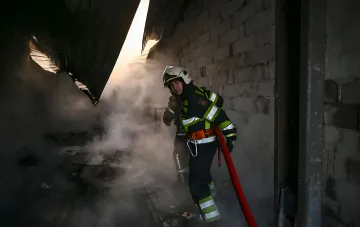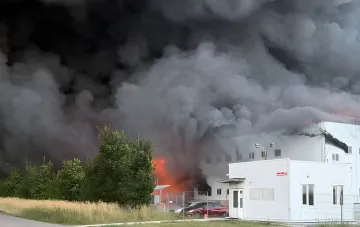

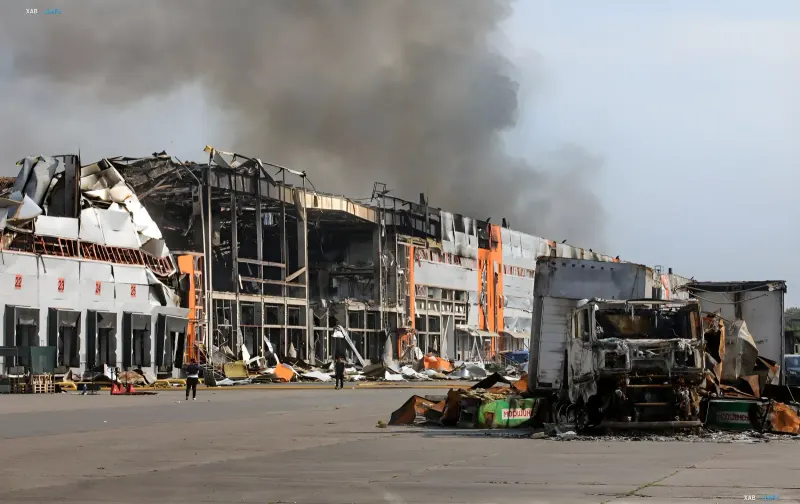
In early August 2026, the Ukrainian grocery retail sector faced an unprecedented crisis triggered by a series of strikes on logistics infrastructure. The primary targets were the distribution centers (DCs) of the largest chains — Fozzy Group ("Silpo", "Fozzy" networks) and Novus. The destruction of these key warehouses, through which the main flow of goods transits, led to local shortages on shelves and forced market players to urgently restructure their supply schemes.
Scale of Destruction and Impact on the Market
According to analysts from Expandia, since the start of the full-scale invasion in February 2022, more than 1.05 million square meters of warehouse space have been damaged in Ukraine. A significant portion of the damage — approximately 750,000 square meters — is concentrated in the Kyiv region. However, the situation escalated specifically in early August 2026: only in the Kyiv region, approximately 100,000 square meters of commercial real estate were put out of commission.
For retailers, this resulted not just in financial losses, but in a physical rupture of supply chains. After August 5, stores of "Silpo", "Fozzy", and "Thrash" experienced interruptions in the availability of certain product categories. Dairy products and tobacco items were the most affected. The assortment on shelves noticeably narrowed, giving way to goods from a limited circle of manufacturers whose logistics routes were managed to be preserved.
Manufacturers' Reaction: From Danone to Philip Morris
The strikes affected not only the retail chains but also the manufacturers themselves. Arsen Didur, Executive Director of the Union of Dairy Enterprises of Ukraine, reported that in the summer of 2026, the capacities of giants such as Danone, Lactalis (brands Lactel, President), and the Yagotyn Dairy Plant came under attack. The destruction of their distribution capacities exacerbated the shortage situation.
The situation in the tobacco industry is also critical. The press service of Japan Tobacco International (JTI) acknowledged that the destruction of distribution centers became a serious challenge requiring a complete restructuring of logistics. The company forecasted that products would return to shelves in full volume by the end of the week of August 10–16. Mykhailo Muller, Commercial Director of Philip Morris Ukraine, noted that while shelves in some stores were already filled, alternative options were being considered for other locations, as direct delivery from the manufacturer to every store is technically impossible without distributors.
The Problem of Switching to Direct Store Delivery (DSD)
The only logical solution in the context of destroyed distribution centers appears to be a switch to the Direct Store Delivery (DSD) model, where goods are delivered directly to retail outlets, bypassing central warehouses. However, experts warn that neither manufacturers nor retailers possess the resources for such a large-scale transformation.
According to Arsen Didur's estimates, about 75% of manufacturers lack the infrastructure, transport, and personnel to service hundreds of stores directly. Switching to DSD would also create a colossal burden on store staff, who would be forced to receive more trucks and work with dozens of suppliers instead of a single center.
Contradictory Data
In the context of the August 2026 events, there are discrepancies in the interpretation of the causes and objectives of the strikes on logistics facilities. Ukrainian sources and retail representatives (Fozzy Group, Novus) characterize the events as an attack on civilian infrastructure, leading to a humanitarian crisis and a shortage of essential goods. At the same time, sources from the Russian Federation (e.g., m24.ru) feature statements that attacks on warehouses (including those mentioned in the context of Wildberries) are retaliatory measures or part of a counter-terrorist operation, creating diametrically opposite narratives regarding the legitimacy and objectives of these strikes.