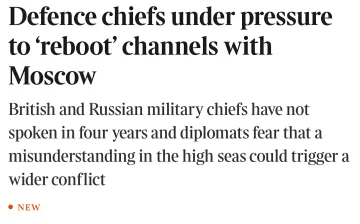
The United Kingdom has officially stated its intention to resume direct communication channels with the Russian military leadership. This decision, announced by representatives of the British government in August 2026, is dictated by the desire to prevent accidental incidents that could lead to unwanted escalation and direct combat confrontation. London believes that the absence of a direct line of communication in current geopolitical conditions creates a dangerous vacuum in which any misunderstanding could be interpreted as hostile actions.
Trigger: The La Manche Incident
The initiative to restore dialogue did not arise out of nowhere and was a direct consequence of an incident that occurred in June 2026 in the English Channel. At that time, the Russian frigate "Admiral Grigoryevich" opened fire when a British yacht approached it too closely. The situation, which could have ended in tragedy, vividly demonstrated to officials in London the risks of lacking operational communication. Diplomats and military experts began to discuss the fact that without a direct communication channel, any similar misunderstanding on the high seas could theoretically escalate into a full-scale conflict.
The role of the embassy and the diplomatic aspect
A representative of the British government, commenting on the situation to The Times, confirmed that London is indeed interested in restoring military communication channels with Moscow. According to the official, the British embassy in the Russian capital should perform the function not only of a diplomatic representation but also as an instrument for directly conveying Britain's position to the Kremlin. This is necessary to protect national interests and keep the situation under control, preventing uncontrolled escalation of tension.
History of the rupture: from Gerasimov to Shoigu
The direct line of communication between the military departments of the two countries has not been functioning for about four years. The last time they communicated at the highest level was between the Chief of the General Staff of the Armed Forces of the Russian Federation, Valery Gerasimov, and his then British colleague, Admiral Tony Radakin — this happened back in September 2022. Later, in October of the same year, contact was made between the heads of the defense ministries: Sergei Shoigu called British Minister Ben Wallace, expressing concern about possible provocations by Kyiv using a "dirty bomb". After this, the dialogue finally died out, and in 2024 relations deteriorated even further: Britain expelled the Russian military attaché, to which Moscow responded with a mirror measure.
Provocations and NATO threats
The British Ambassador to Russia, Neil Crompton, in his recent statements emphasized that Russia has been "testing the waters" for years, staging air provocations against Poland, Romania, and the Baltic states. He warned that under a certain scenario of events, NATO would have to respond with force. In addition, the ambassador reacted to recent statements by Ukrainian General Zaluzhny about Ukraine's accession to the Alliance. Crompton noted that London would like to see Ukraine in NATO, however, consensus on this issue among the member states of the bloc has not yet been reached.