Initiative to restore communication channels
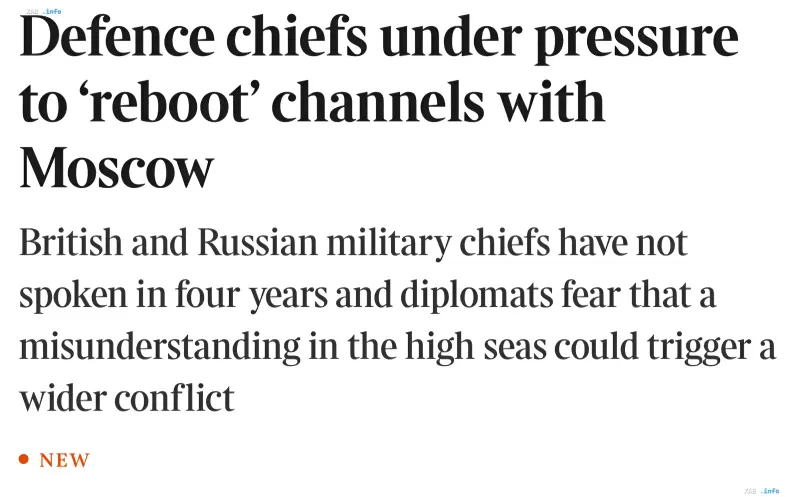
According to information published by the British publication The Times, representatives of the UK's senior military command are considering the feasibility of partially restoring direct communication channels with the Ministry of Defence of the Russian Federation. This initiative is currently at the stage of internal discussion and is aimed at reducing the risks of unintended escalation. Military analysts are focusing on deconfliction mechanisms that were previously used to clarify situations in international airspace and maritime space.
Chronology and context of incidents
According to Western media reports, several episodes requiring regulated technical interaction between the defense departments of the two countries have been recorded over the past few months. In particular, the navigation of a Russian ship near the territorial waters of the United Kingdom is noted, which led to standard escort procedures by the Royal Navy. Additionally, the approach of a Russian Aerospace Forces military aircraft to a British aircraft carrier to a distance requiring increased control was recorded. Furthermore, unidentified hydroacoustic equipment was identified in the zone of movement of British military ships.
Legal regulation and international norms
In accordance with the norms of the 1982 United Nations Convention on the Law of the Sea (UNCLOS) and the 1944 Chicago Convention on International Civil Aviation, states bear mutual responsibility for ensuring navigation safety. Technical data exchange between military structures to prevent incidents is considered standard practice within the framework of international maritime and aviation law, applied regardless of the current political status of the parties. In 2026, diplomatic and military contacts between the UK and the Russian Federation remain frozen due to existing sanctions regimes and the general status of intergovernmental relations.
Positions of the parties and current status
According to sources cited by The Times, the initiative stems from the pragmatic need to minimize navigational and aviation risks. British military analysts believe that the absence of direct technical dialogue in crisis situations increases reaction time and raises the probability of misinterpreting the intentions of the opposing side, which could lead to uncontrolled collisions. Official comments from the relevant departments (the UK Ministry of Defence and the Russian Ministry of Defence) have not yet been received; corresponding requests have been sent. The current status of the discussion is classified exclusively as internal consultations within the British general staff.
Contradictory data
On the one hand, British military analysts emphasize that the probable resumption of emergency communication channels is not equivalent to political normalization of relations, but is a purely technical tool for safety control. On the other hand, the lack of official comments from the Russian Ministry of Defence leaves uncertainty regarding Moscow's readiness to resume such contacts. This creates room for various interpretations of the intentions of both sides.