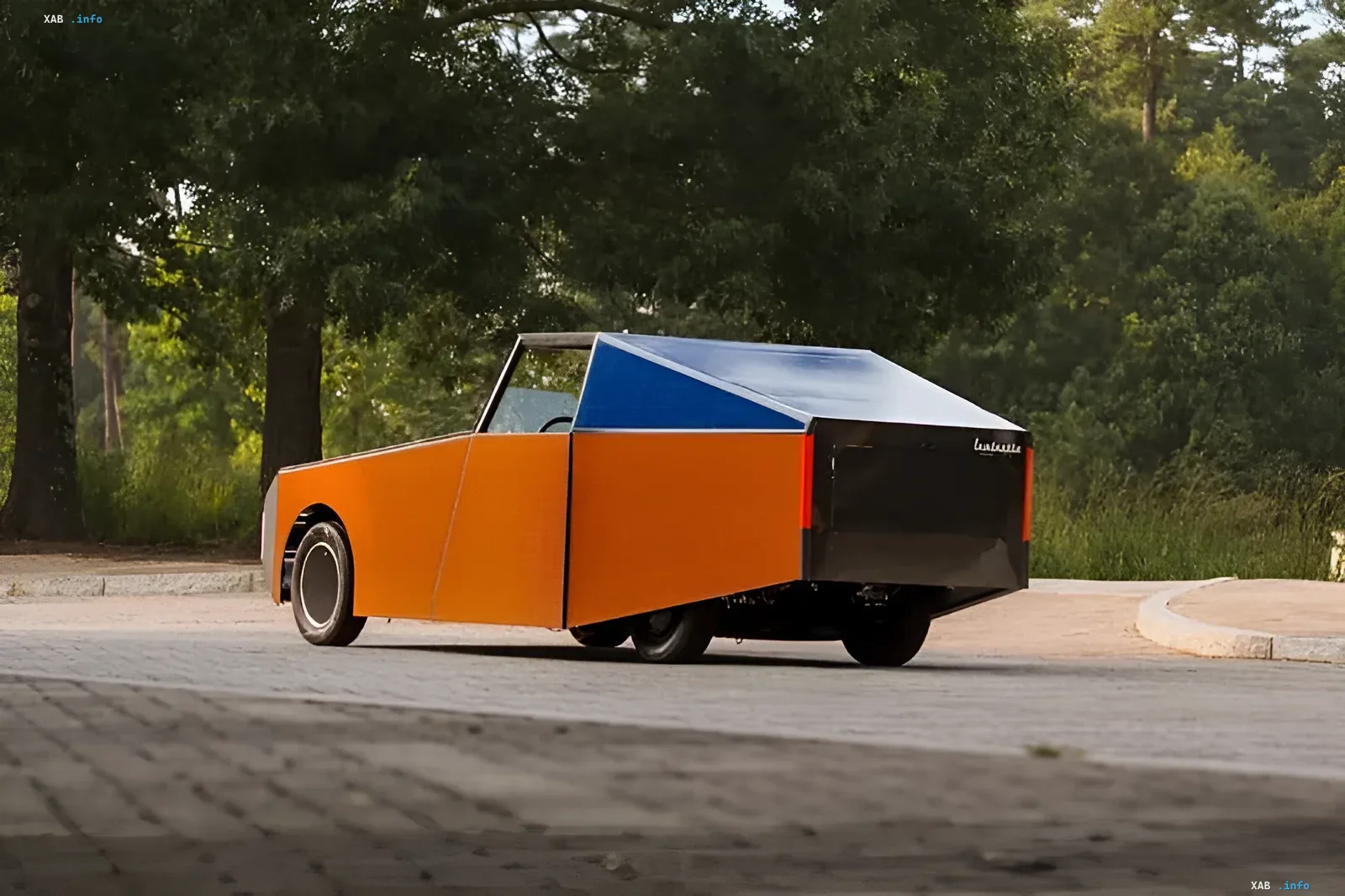
In a world where automotive design is moving towards aerodynamic contours and minimalism, the appearance of the Luminetta prototype came as a real shock to the industry. Developed by graduate students at Clemson University with support from BMW, this experimental solar car, also known as Deep Orange 17, looks so angular and bulky that journalists and social media users compare it to structures from Minecraft. Against its backdrop, even Elon Musk's Cybertruck seems organic and smooth. However, behind its unassuming, almost brutalist exterior lies an ambitious scientific goal: to create a vehicle capable of generating more energy than it consumes for movement.
Physics vs. Aesthetics: The Architecture of Luminetta
The main secret to Luminetta's efficiency lies in its radical approach to construction. The vehicle's mass is only 550 kg, comparable to specialized track cars like the Caterham 7 or Ariel Atom. This weight reduction was achieved through the use of a skeletal chassis with 3D-printed metal joints and lightweight composite body panels. Instead of traditional stamped bodywork, engineers chose a shape resembling geometric primitives to maximize the surface area for placing photovoltaic elements. This decision allowed them to forgo complex aerodynamics in favor of pure energy balance mathematics.
"Solar Skin" and Fraunhofer Technologies
The key innovation of the project was the photovoltaic cladding developed in collaboration with the German Fraunhofer ISE institute. Unlike the rigid flat panels often found on solar cars, Luminetta is covered with flexible, shade-tolerant "solar skin." This technology allows energy generators to be integrated directly into the body panels, making them an integral part of the structure. According to calculations by Clemson University, a typical daily trip of 20 km requires only 1.6 kWh of energy. Meanwhile, under optimal lighting conditions, the car can collect up to 5.7 kWh per day, leaving a surplus for approximately 50 km of range.
Contradictory Data
Despite the developers' optimism, there are discrepancies within the automotive expert community regarding the vehicle's actual potential. On one hand, BMW and the university claim to have achieved "energy-positive" status, a claim supported by calculations from Stefan Augustin, BMW's research project manager. On the other hand, skeptics point out that the efficiency math only works under ideal conditions: on an open parking lot, in clear weather, without shadows from trees or buildings. Furthermore, there are discrepancies in range estimates: some sources (such as Motorpage) report a self-charging potential of 70 km, while university calculations indicate 50 km. Questions regarding safety and comfort also remain, as Luminetta was not designed as a production car.
Prototype Philosophy: Rejecting Marketing
"This is a project we wanted to implement for years, and it is incredibly gratifying to see students overcome so many technical limitations in two years and create an energy-positive vehicle," noted Stefan Augustin. Luminetta is a radical prototype demonstrating what happens when marketing, safety, and style are discarded for pure physics. It is not a car for sale, but a proof of concept showing the limits of the possible in the field of solar energy in transport. In the context of 2026, when the search for alternative energy sources becomes increasingly relevant, Luminetta serves as an important benchmark for future developments.