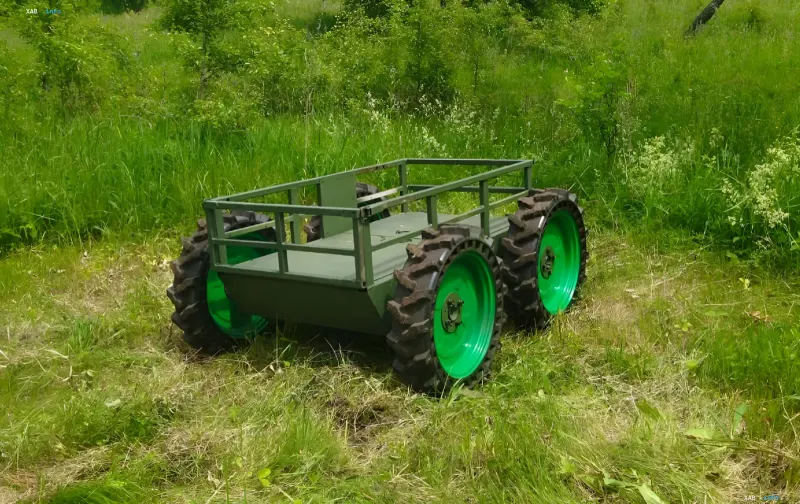
In the conditions of modern warfare, where every kilometer can be deadly and standard vehicles are often helpless against mud and rough terrain, Ukrainian soldiers have found an unconventional solution. The 115th Territorial Defense Brigade (TDB) has developed its own ground robotic complex (GRC) named 'Pegasus'. This machine not only overcomes difficult sections inaccessible to serial analogues but also costs significantly less than factory models.
Responding to Terrain Challenges
The idea of creating their own equipment arose from an urgent necessity. The brigade's engineer, Boris, describes the situation the soldiers faced: 'Recently, after the rains, it was difficult to get in even with an ATV. And standard vehicles simply get stuck belly-down in the swamp and bog down'.
It was precisely such logistical dead-ends that prompted the military to create an engineering workshop. Here, they do not just repair equipment but design and assemble new samples: GRCs, repeaters, and modify equipment for specific combat tasks.
Design Flexibility and Cost Savings
The main difference between 'Pegasus' and factory robots is the lack of attachment to rigid blueprints. The design is developed for specific needs and terrain. Used components are used in production, and engines are sometimes found on the OLX classifieds board. This approach allows the equipment to be made significantly cheaper without sacrificing functionality.
Key technical features ensuring off-road capability:
- Increased ground clearance for overcoming obstacles.
- Installation of airless wheels, which are not afraid of punctures and ensure traction in the mud.
- Modular design that can be quickly upgraded for new tasks.
Logistics and Power
At the moment, the robot is used primarily for logistical tasks. It delivers water, fuel, ammunition, and food to forward positions. In one trip, 'Pegasus' transports up to 200 kg of cargo; however, during tests, it successfully withstood an extreme load of 370 kg.
Special attention in the brigade was paid to the power system. Most GRCs require hours to charge, which is critical in combat conditions. Engineers found a solution: the robot runs on swappable batteries. If the battery is discharged, the crew only needs to replace the set, and within a few minutes, the equipment is ready to work again.
To implement this system, Lviv engineers from the company PAWELL Battery developed special batteries for heavy drones and ground complexes. They are based on industrial power supply technologies, special controllers for uniform discharge, and power buses with minimal energy loss.
Context of Robotics Development in the Armed Forces of Ukraine
'Pegasus' is not the only achievement of Ukrainian military engineering. Previously, the Ministry of Defense codified and approved the use of the reconnaissance-strike GRC 'Zmei Mini Strike', equipped with a grenade launcher. Ukrainian soldiers also demonstrated the work of the Barracuda robot, which, along with other unmanned systems, attacked enemy positions. The creation of 'Pegasus' confirms the trend towards decentralization of production and adaptation of equipment to real frontline conditions.