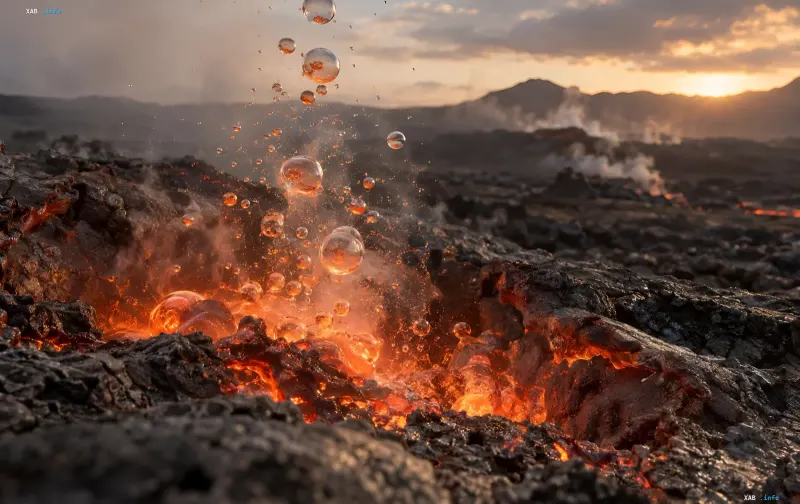
Deep within the planet, at depths where pressure is measured in tens of gigapascals, molten rock is capable of storing oxygen in quantities that geologists previously considered impossible. This is evidenced by a study published in the journal National Science Review (Oxford Academic), as reported by RBC-Ukraine. An international team of scientists demonstrated through laboratory experiments that under immense pressure, magma absorbs additional oxygen as an independent gas component — alongside water or carbon dioxide. As the melt rises toward the surface, pressure drops, and the rock gradually releases the accumulated gases. According to the authors' calculations, this exact mechanism billions of years ago could have been key in forming a breathable atmosphere.
Revising the Established Mantle Model
For a long time, the geological community was dominated by the model stating that all oxygen present in Earth's mantle is tightly bound to other elements — predominantly silicon or iron within silicate and oxide minerals. The idea that oxygen could exist in molten rock as a separate, "free" phase was considered unlikely. However, new experiments challenge this paradigm: researchers showed that at pressures characteristic of deep mantle layers, magma can retain a significant volume of molecular oxygen integrated into the crystal lattice at the atomic level, rather than merely being trapped as bubbles.
Laboratory Experiment: Artificial Rock and Platinum Oxide
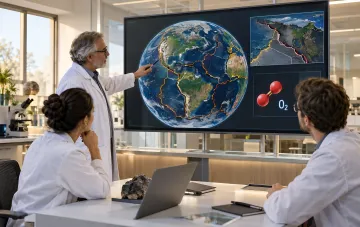
To test the hypothesis, scientists created an artificial analogue of oceanic volcanic rock and added platinum oxide to it, thereby generating an oxygen-rich environment simulating deep-melt conditions. Using a combination of spectroscopic methods and computer modeling, the researchers confirmed that oxygen indeed embeds into the melt structure, forming special chemical bonds. This is not mechanical gas "trapping" in pores, but a full-fledged atomic inclusion, which fundamentally changes our understanding of volatile component transport in the mantle.
From Mantle to Atmosphere: The Release Mechanism
When magma from deep mantle layers rises — whether due to tectonic rifting, volcanic activity, or the formation of large igneous provinces — the pressure within it decreases. Having lost the ability to hold a large amount of dissolved gases, the rock begins to gradually release them outward. Under the conditions of ancient Earth, when volcanic activity was orders of magnitude more intense than today, the total volume of released oxygen could have been colossal. The study's authors emphasize that this mechanism solves an enigma of our planet's past that geologists and geochemists have tried to unravel for decades.
Large Igneous Provinces and "0.27 Percent"
Between 2.5 and 2 billion years ago, massive eruptions of huge volumes of lava occurred on Earth — the so-called Large Igneous Provinces, whose traces remain in the geological record. According to the scientists' calculations, if the magma at that time released just 0.27 percent of its mass as excess oxygen, it would have been enough to fill Earth's entire modern atmosphere with oxygen. Thus, even a relatively insignificant fraction of released gas on the scale of ancient volcanic events can explain the appearance and accumulation of free oxygen in the atmosphere.
Context: How Oxygen Secured Its Place in the Atmosphere
A separate study conducted by scientists at the University of California, Riverside, and published in the journal Earth complements the picture from another angle: it explains why the oxygen that appeared in the atmosphere about 2.3 billion years ago during the Great Oxidation Event was not reabsorbed. According to this work, a key role was played by the increase in available phosphorus in ancient oceans, which stimulated the development of living organisms and the burial of organic carbon in marine sediments. Thus, two independent mechanisms — deep release of oxygen from magma and biogenic fixation in the atmosphere — together form a cohesive picture of the origin and preservation of Earth's oxygen.