In the world of materials science, a debate has been raging for many years. Ruthenium dioxide (RuO2) is a material whose magnetic properties have remained a mystery. Some researchers claimed it was magnetic, while others found no signs of magnetism. Now, physicists have taken a step toward solving this mystery, showing that the reason for the contradictions lies not in the substance itself, but in the peculiarities of its atomic structure.
How Stretching Changes Physics
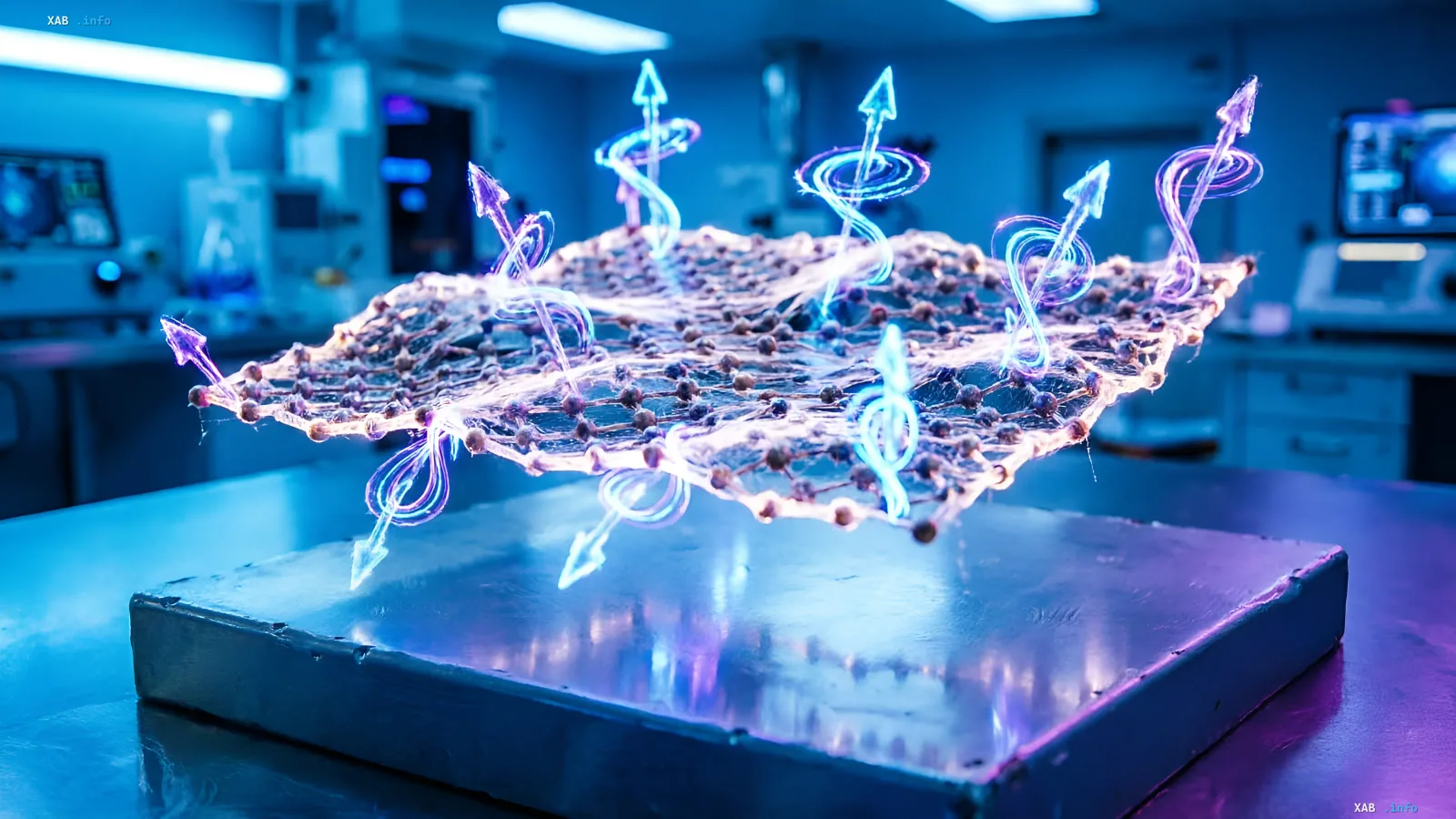
In a new experiment, scientists created ultrathin RuO2 films only about two nanometers thick. These films were grown on a titanium dioxide substrate. Due to a slight mismatch in the parameters of the crystal lattices, the film turned out to be slightly stretched. This mechanical stress changed the mutual arrangement of atoms and the nature of electron interactions within the material.
To study the structure, researchers used spin- and angle-resolved photoemission spectroscopy (spin-ARPES). This method allows for the simultaneous determination of the energy, direction of motion, and spin of electrons. The measurements revealed an unusual distribution of spins—a characteristic sign of magnetic ordering.
A New Magnetic State
Additional checks showed that the discovered effect cannot be explained by features of the crystal structure or experimental errors. According to the authors of the study, the most likely cause was the emergence of a new magnetic state caused precisely by the mechanical stretching of the ultrathin film.
The results obtained indicate that the magnetic properties of RuO2 are not constant. They can be changed or even "turned on" by controlling the deformation of the crystal lattice. This also explains why previous studies often came to opposite conclusions: in bulk crystals and thicker films, where mechanical stress is virtually absent, such an effect might simply not have manifested.
Prospects for Spintronics
The discovery is particularly important for research into altermagnets—a new class of magnetic materials in which interest is growing rapidly in recent years. Unlike conventional magnets, altermagnets create virtually no external magnetic field but maintain magnetic order at the electron level. Because of this, they are considered one of the most promising materials for spintronics—a field of electronics where information is transmitted and processed using not only electric charge but also electron spin. Such technologies could potentially allow for the creation of faster and more energy-efficient electronic devices.
Limitations and Next Steps
However, the authors of the study are not yet rushing to final conclusions. The observed state could be not only a manifestation of altermagnetism but also weak ferromagnetism. Additional experiments will be required to accurately determine the nature of the effect.
There is also another important limitation. All measurements were conducted at a temperature of only 15 Kelvin (about -258 °C). It is currently unknown whether the discovered magnetic properties can be maintained at room temperature—and this is the key condition for using the material in real electronic devices.