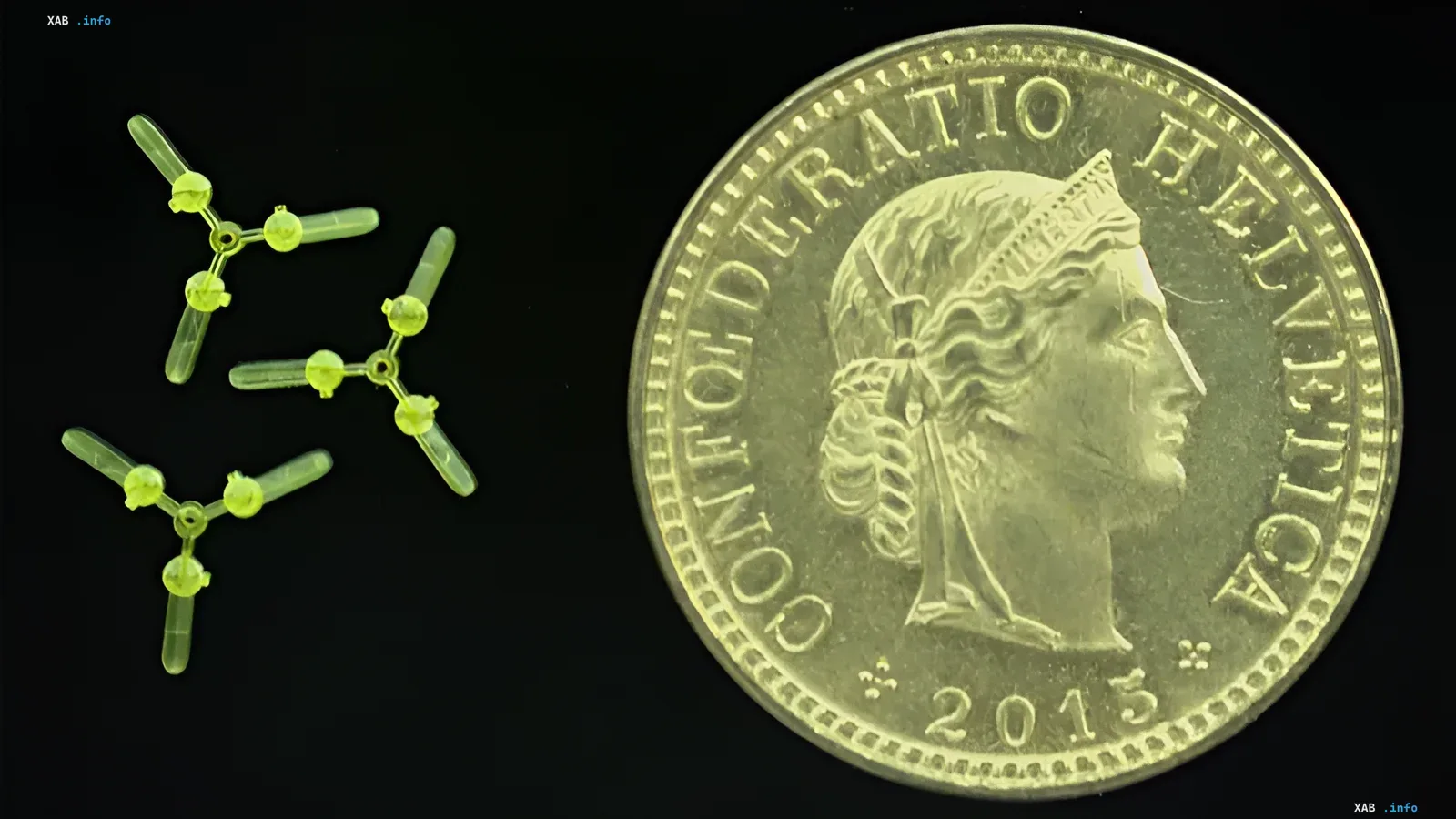
In the world of microelectronics and robotics in 2026, engineers continue to seek ways to miniaturize devices, moving away from traditional power sources. A breakthrough that could change the approach to creating microrobots has been made by scientists from the École Polytechnique Fédérale de Lausanne (EPFL). The team has developed unique miniature engines capable of converting sound waves directly into mechanical thrust. The main advantage of this technology is complete independence from electric motors, batteries, and complex onboard electronics, which traditionally act as a "bottleneck" in the creation of micro-devices.
The physics of sound: from a humming bottle to jet thrust
The new technology is based on a fundamental physical phenomenon known as Helmholtz resonance. Many of us have encountered it in daily life: if you blow across the neck of an empty bottle, it begins to produce a sound. Scientists from the MicroBioRobotic Systems (MICROBS) laboratory decided to use this effect in reverse. Instead of sound being a byproduct, it became the source of energy.
Researchers created hollow resonators of round and bell-like shapes. The size and geometry of these cavities were mathematically tuned to specific sound frequencies. When a sound wave of the correct frequency acts on the resonator, the air inside the cavity begins to oscillate intensely. This turns a simple hollow structural element into a fully functional acoustic micro-engine.
The principle of asymmetry: how sound pushes forward
The key to generating thrust is the asymmetry of air flows. With each acoustic oscillation, air enters the resonator in a relatively scattered stream but is forced to exit through a narrow opening as a more concentrated and faster jet. Thanks to this, the average momentum of the outgoing flow acquires a clear direction, and the structure receives reactive thrust similar to that generated in rocket engines.
This method is fundamentally different from acoustic levitation, where an external sound field holds a passive object. In the new scheme, sound "pumps" energy into a resonator built into the device, and the robot itself generates the driving force. Such cavities can be easily manufactured using 3D printing from plastic, glass, or other materials, making the technology accessible for mass production.
From boats to flying microrobots
To demonstrate the viability of the technology, researchers went from simple models to complex flying vehicles. First, miniature centimeter-sized boats with one, two, or three acoustic resonators were created. Each cavity was tuned to its own frequency in the audible range. By changing the frequency of the signal from an external speaker, engineers could selectively activate different "engines," causing the boat to move forward, turn, or navigate around obstacles. This demonstrated the possibility of programmable autonomous movement without using onboard computers.
Then, using three-dimensional nano-printing, the team manufactured flying microrobots. One of the devices, weighing only 150 micrograms, generated upward thrust using acoustic jets, functioning like a tiny rocket. In another design, resonators rotated miniature blades at speeds up to 13,000 revolutions per minute, creating lift on the principle of a helicopter. These devices operated at ultrasonic frequencies inaudible to humans.
The future of acoustic robotics
According to the developers, further miniaturization will allow the creation of flexible robots with multiple resonators. Each of them will be able to respond to its own frequency and independently bend, rotate, or change individual parts of the device under the influence of sound. This opens up prospects for creating micro-fleets capable of penetrating hard-to-reach places for inspection, drug delivery, or data collection in hazardous environments where the use of electricity is impossible or dangerous.