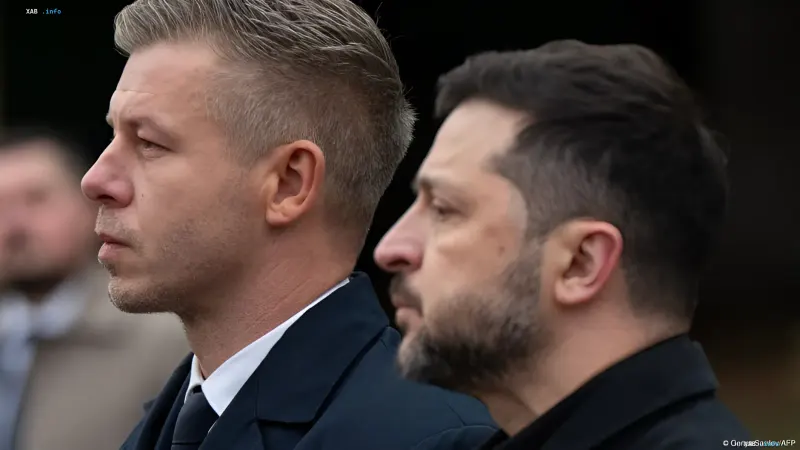
On November 24, 2026, Hungarian Prime Minister Peter Magyar paid his first official visit to Ukraine in this capacity and held a meeting with President Volodymyr Zelenskyy. The day began with a memorial ceremony: the politicians laid wreaths at a cemetery in Uzhhorod, where soldiers who died in the war in Ukraine are buried. According to Magyar, an ethnic Hungarian who died at the beginning of Russia's full-scale invasion is also laid to rest there. The gesture served as a signal that Budapest is establishing a new tone in its relations with Kyiv — through the acknowledgment of victims and shared obligations, rather than just through negotiation positions.
Memorial ceremony as a political gesture
Choosing Uzhhorod as the first stop of the visit had an obvious symbolic meaning. In a post on X, Volodymyr Zelenskyy emphasized that "our ability to live in a free country, as well as the safety of our neighbors and all of Europe, comes at a huge cost — a cost that Ukraine pays every day," and that "it is our duty to remember all those who gave their lives in this struggle." The Ukrainian leader thanked Magyar for starting his visit by "showing respect to the Ukrainians who defended our state." Thus, the parties managed to immediately ease some of the emotional tension and set a framework for dialogue where the Hungarian side acts not as a critic, but as a neighbor acknowledging the price Ukraine is paying.
Energy, infrastructure, and working groups
Beyond the ceremony, the parties moved to a practical agenda. According to the dpa agency, the discussions covered gas and diesel fuel supplies to Ukraine, joint projects including direct rail connections between the two countries, and demining of territories. Zelenskyy clarified that agreements have already been reached in the areas of policy, energy, and infrastructure, and working groups have been established for their implementation. This is an important shift: it concerns mechanisms with concrete responsible bodies rather than mere declarations of intent, which increases the probability of the agreements being fulfilled in the medium term.
The question of the Hungarian minority — the key to unlocking
A few days before the visit, Magyar stated he wanted to discuss the observance of the cultural rights of the Hungarian minority living in Ukraine with Kyiv. Before the war, this population numbered about 130,000, but it is reported to have decreased since then. The Hungarian Prime Minister said he would ask Zelenskyy to accelerate the implementation of the relevant legislation before the end of the current year or early next year. The context here is critical: on October 12, the Verkhovna Rada adopted a bill on ensuring the rights of national minorities and indigenous peoples in education, which was one of the key steps for Hungary to unlock further progress in Ukraine's EU accession negotiations. Thus, the minority issue is not an isolated topic, but a connecting link between the bilateral agenda and Kyiv's European integration.
Brussels background: from closed-door talk to official visit
The official visit to Ukraine was not the two leaders' first contact. On October 16 in Brussels, on the sidelines of the EU summit dedicated to closing the fourth and fifth clusters, a closed-door meeting between Zelenskyy and Magyar took place without delegation members. It is reported that two main topics were discussed: the situation of Hungarians from the Zakarpattia region (including changes in the education law and recognition of the 1944–1945 deportations) and Russia's war against Ukraine, regarding which Magyar expressed support for Ukrainians. On November 23, Zelenskyy emphasized that the meeting with Magyar was important for both bilateral relations and Ukraine's EU accession, stating: "We are doing everything necessary to open clusters in the negotiations on Ukraine's accession to the European Union." The logic of progression — from an informal contact in Brussels to a state visit to Kyiv — indicates the purposeful work of both sides to overcome the Hungarian veto.
What this means for Kyiv-Budapest relations
The visit on November 24, 2026, marks a paradigm shift in relations between Ukraine and Hungary: the dialogue is moving from the realm of mutual recriminations to that of practical agreements — on energy, transport, demining, and minority rights. For Kyiv, this is a way to remove one of the key obstacles on the path to the EU; for Budapest, it is an opportunity to cement influence in Zakarpattia while simultaneously distancing itself from an isolationist position. The established working groups and the attachment to the "end of the year — beginning of the next" deadline turn political will into a verifiable schedule. The next indicator will be how quickly these mechanisms begin to yield concrete results — from the first fuel deliveries to the actual launch of direct rail links.