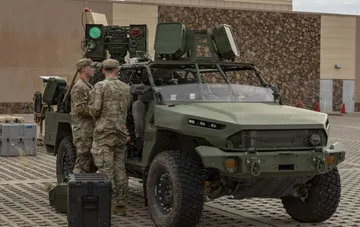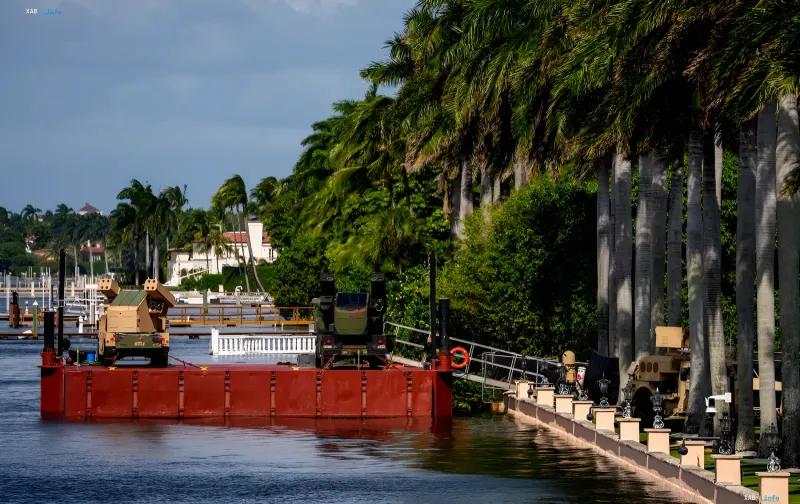
At least one AeroVironment LOCUST counter-drone laser system has been spotted near U.S. President Donald Trump's Mar-a-Lago estate in Florida, according to RBC-Ukraine, citing The War Zone (TWZ). The laser system, mounted on a Joint Light Tactical Vehicle (JLTV), appeared in two photographs taken on October 31 by Getty Images photographer Andrew Harnick. The exact date the system was deployed on the estate's grounds remains unconfirmed.
Comprehensive Defense: From Floating Platforms to Radio Direction Finding
According to TWZ, the primary subjects of Harnick's photographs were two AN/TWQ-1 Avenger mobile air defense missile systems based on Humvees, deployed on a floating platform in the Lake Worth Lagoon near the estate's border. They were delivered there for the first time a little over two weeks before the photos were published. Additional Avenger systems, the publication reports, were stationed near the Donald Trump International Airport, located about five miles to the west. Nearby elements of Counter-Unmanned Aircraft System Fly-Away Kits were also deployed, including a Ku-band radar, electronic support measures (ESM), electronic warfare equipment, and 360-degree infrared search and track systems.
Official Confirmation and Reasons for Enhanced Security
NORAD and USNORTHCOM commands told TWZ that ground-based air defense and counter-UAS assets were deployed in the Mar-a-Lago area at the request of the U.S. Secret Service. They stated that these assets provide "an additional technological layer of protection," while declining to provide further details due to operational security concerns. The Secret Service itself stated that it operates under a heightened threat environment and continuously deploys cutting-edge technologies to protect protectees. TWZ links the increased security to signs of a potential new round of major hostilities with Iran and preparations for the U.S. midterm elections, noting that Iranian authorities have repeatedly threatened Trump, who has already faced multiple assassination attempts and domestic threats.
The LOCUST Program and Combat Experience
The U.S. Army began receiving LOCUST variants based on the JLTV and the lighter Infantry Squad Vehicle last year under the Army Multi-Purpose High Energy Laser (AMP-HEL) program. Procurements are currently being conducted under the Enduring-High Energy Laser program: the LOCUST X3 system has a power output of 30 kW, putting it at the lower end of the high-energy laser class, and is specifically designed to counter small drones. This is not the first deployment of LOCUST in operational conditions: in 2022, the Pentagon confirmed the deployment of two systems of the previous palletized P-HEL version to undisclosed overseas locations, and this year AMP-HEL systems appeared along the Mexican border, including an incident involving the closure of airspace around El Paso, Texas, in February. Following this, the Pentagon entered into a new agreement with the Federal Aviation Administration (FAA) regarding the use of laser weapons within the United States.
Technology Limitations and International Context
TWZ recalls the technical limitations of such systems: lasers engage only one target at a time, lower-power systems require time to maintain the beam on target, and weather, smoke, and dust reduce beam power; operational range is typically measured in miles. Counter-drone laser weapons remain an actively developing field: on September 3, the UK Ministry of Defence launched the PANOPTES project to develop an autonomous armored vehicle-mounted laser air defense system to combat swarms of cheap drones, allocating up to £5 million for the first phase, with work scheduled to begin in November-December 2026. On September 24, the U.S. Army published photos of the AMP-HEL laser on an Infantry Squad Vehicle being tested at Fort Bliss, Texas.