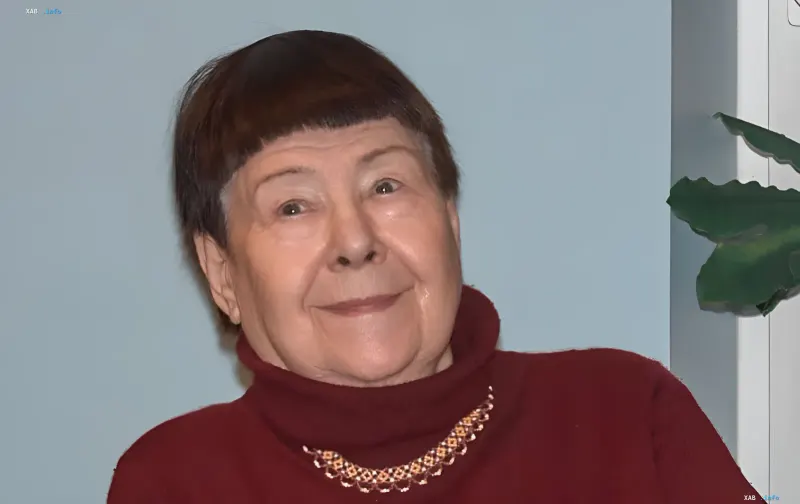
On September 8, 2026, Ukrainian journalist, dissident, and public figure Margarita Dovhan passed away at the age of 95. This was announced by her daughter, Kateryna Dovhan, on Facebook, who noted that the funeral would be held in a private setting and that information about a memorial evening would be shared later. According to her loved ones, Margarita Dovhan missed her 96th birthday by just three days — her birthday falls on September 11. The loss is a significant event for Ukrainian culture and the human rights community, as Dovhan had been one of the symbols of the Kyiv dissident movement for decades and a voice for those persecuted by the Soviet regime.
A Sixtiers' Circle Member from the Circle of Stus and Kostenko
Margarita Dovhan was born in 1930 in Tashkent, where her family had been forced to relocate due to Stalinist repressions. In 1944, the family settled in Kyiv, where Dovhan later received a journalism education at Taras Shevchenko University and worked at the publications 'Evening Kyiv' and 'Friend of the Reader.' In the 1960s, together with her husband, sculptor Borys Dovhan, she became part of the Kyiv circle of the Sixtiers: she organized literary gatherings, befriended Ukrainian artists and writers, and actively supported those persecuted by the Soviet authorities. It was during this period that her long-standing ties with Vasyl Stus and Lina Kostenko were formed.
Summons to the KGB and a Lifelong Bond with Vasyl Stus
The turning point came in the autumn of 1965: after a poetry evening organized by Dovhan, at which, among others, Vasyl Stus and Lina Kostenko performed, she was summoned to the KGB and ultimately lost her job. Notably, the journalist had worked for three years alongside Stus in the information department of the Ministry of Building Materials Industry. After his arrest and imprisonment, Dovhan did not sever her connection with him: she corresponded with the poet and helped his wife, Valentyna Popeluh. 'I wrote most to Vasyl Stus. I tried to support his wife, Valeta,' Dovhan herself recalled in an interview. In September 1985, after the news of the poet's death, she and a friend traveled to the camp at Kuchino, hoping to bring his body back to Ukraine, but on site they were told that Stus had already been buried.
From Dissidence to Public Activity
After the collapse of the Soviet system, Dovhan continued her public activity in independent Ukraine. In the early 1990s she worked with the People's Movement of Ukraine, and later took part in the Orange Revolution and the Revolution of Dignity. Thus, her biography spans almost the entire period of the country's postwar and modern history — from Stalinist repressions and the dissident underground to contemporary civic movements — making her figure a rare living link between generations.
'Hospital Notes': The Voice of Wounded Soldiers
At the end of 2014, against the backdrop of the full-scale conflict in eastern Ukraine, Dovhan began visiting wounded Ukrainian soldiers at a Kyiv hospital. Their personal stories and experiences formed the basis of her book 'Hospital Notes. February 2015 — March 2018,' published in 2018. This work became the culminating accent of her journalistic and human mission — to document the fates of people who, like herself in the 1960s, found themselves at the intersection of personal tragedy and great history.
Farewell
Margarita Dovhan's family announced her passing on September 8 and asked for understanding that the funeral would be held in a private format. The date and location of the memorial evening will be announced separately. Having passed away three days before her 96th birthday, Dovhan left behind a legacy that extends far beyond a single profession: it encompasses dissident steadfastness, a lifelong friendship with Vasyl Stus, civic participation in the key events of independent Ukraine, and a book in which the voices of wounded soldiers are heard.