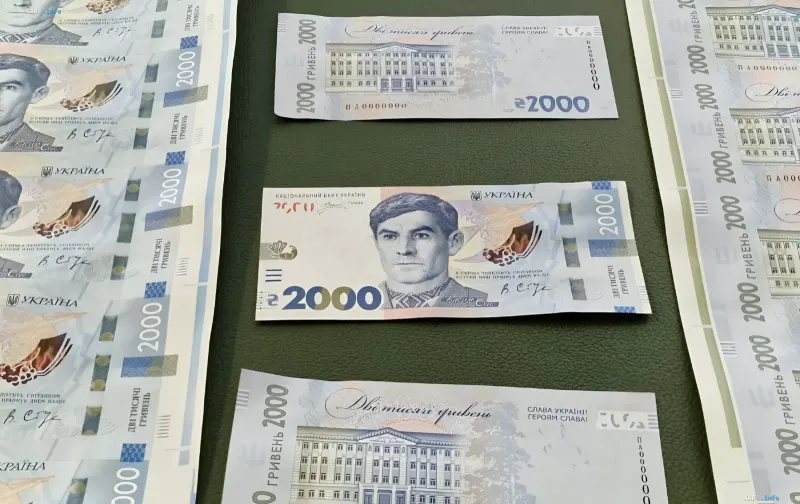
The National Bank of Ukraine has clarified a key question that arose among market participants and the media following the launch of the new denomination: the 2,000-hryvnia banknote is not intended to replace any single existing denomination, including the 1,000-hryvnia note. This was stated by the regulator's press service in response to a request from RBC-Ukraine. According to NBU representatives, the move is about optimizing the overall structure of cash circulation, not about withdrawing a particular denomination from circulation. The new note will gradually replace a portion of banknotes of various denominations in line with the actual needs of cash circulation.
How exactly the replacement will take place
The regulator emphasized that the issuance of 2,000-hryvnia banknotes will be carried out within the planned volumes and primarily to replace worn-out and damaged banknotes of other denominations. Thus, the new highest-denomination note in the history of the hryvnia will not "crowd out" any specific denomination, but will gradually replace a portion of notes of different values — depending on the needs of cash circulation. This approach allows for flexible management of the mass of cash in circulation without sharp structural shifts.
Economic effect on the system
The NBU also provided a practical calculation: one 2,000-hryvnia banknote can replace two 1,000-hryvnia notes or four 500-hryvnia notes. According to the regulator's estimates, this will reduce the costs of producing, transporting, collecting, processing, and storing cash. For banks and cash-in-transit services, this means fewer physical units for the same amount, which lowers the logistical burden and the costs of the entire cash circulation system.
Presentation copies with zero numbering
Separately, the NBU explained the fate of the special copies produced for the presentation of the new banknote. Several dozen copies were made for the presentation, all with zero numbering and in compliance with the corresponding requirements for maintaining a regime of confidentiality. These banknotes were used to configure banking equipment before the launch of the new denomination and are not intended for use in cash circulation. After the presentation, such copies are stored at the NBU's Banknote and Coin Mint as samples of internal-procedure products.
Launch context: the portrait of Vasyl Stus
Recall that the NBU put the 2,000-hryvnia banknote into circulation on September 4, 2026. The new note features the Ukrainian poet, dissident, and Hero of Ukraine Vasyl Stus. It became the highest denomination in the history of the hryvnia, making the launch not only a technical but also a symbolic event for the national currency.
Contradictory data
The regulator's official position and part of the expert assessment diverge in their interpretation of the launch's consequences. The NBU insists that the issuance of the 2,000-hryvnia note is a tool for optimizing the structure of cash circulation, not linked to replacing one denomination with another and carrying no direct threat to prices. At the same time, a number of media outlets and analysts, in publications from July 2026, viewed the appearance of the new denomination as a possible signal capable of influencing inflationary expectations, raising the question of whether the NBU's step is timely or could be perceived by the market as a harbinger of rising prices. Thus, the difference lies not in the facts of the issuance, but in the assessment of its macroeconomic resonance: the regulator sees logistics and costs, while some observers see a psychological effect on expectations.