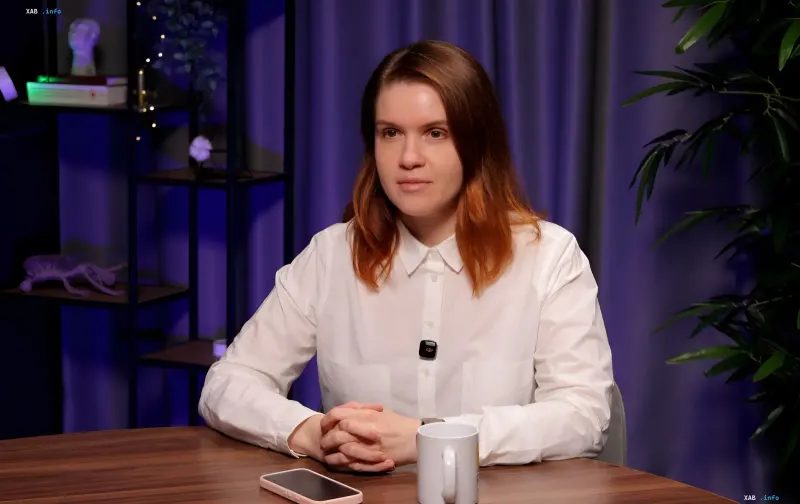
MP Mariana Bezuhla, known in the Ukrainian political space for her criticism of the military command and high-profile statements on defense reform issues, gave an extensive interview to RBC-Ukraine's project "Don't Interrupt!" with Volodymyr Kurennyi. In the conversation, the MP assessed the work of the military leadership, commented on the stability of the front-line situation, and outlined her position on a number of systemic issues ranging from mobilization policy to education. Below are the key points of the conversation, published in an abbreviated version on the RBC-Ukraine website; the full recording is available on the outlet's YouTube channel.
Women in the registry of conscripts: from "Reserve+" to hype and rollback
Bezuhla confirmed that she advocates for the inclusion of women in the military registration system and has not hidden this position "from the very beginning." According to her, she headed the working group on the first stage of the TCR reform, during which military enlistment offices were renamed into centers for recruitment and social support. It was then, she claims, that the norm on creating a registry of conscripts—the precursor to the "Reserve+" platform—was established. The MP emphasizes that it was a question of an electronic accounting system for all citizens, because, in her wording, "there are no two types of citizens in the Constitution of Ukraine." However, in her assessment, after public hype arose around the potential mobilization of women, several Verkhovna Rada colleagues introduced amendments that resulted in even those women who were already registered—specifically female signalers—being removed from the registry. Only medics were left, Bezuhla notes. "But now various specialties are extremely important, in particular engineers and IT specialists. We actually cannot see what our reserve is," the MP stated.
Booking: between corruption and the loss of engineers
The second block of the interview is devoted to limiting the booking of employees. Bezuhla advocates for the most stringent restrictions on booking, with an emphasis on defense-industrial complex enterprises. At the same time, she points to systemic corruption: "Ukrainians are quite corrupt at various levels," from apartment block associations (HOAs) to the ability to "pay to be booked." The MP cites the example of creating defense companies that "actually produce nothing, but simply trade positions for booking." At the same time, Bezuhla warns against the risk of overdoing it: at the beginning of the full-scale invasion, according to her, "tens and hundreds of engineers were mobilized into the infantry." She asks a rhetorical question about how many people with specialized competencies died who could have built drones while working in their field. "If a person has a specialization that is very much needed by the army and cannot be learned in a few months, they must be properly engaged," the MP summarized.
Militarization of schools: drones as a mandatory subject
When asked about the militarization of society, Bezuhla called it the "only way" for Ukraine and described it as a "change in mentality" and "service for everyone." She formulated her position most concretely regarding school education: "Every child in school must learn to operate a drone, because our enemy is learning this." In her conviction, in the near future drones will be needed not only for military purposes—from ground robots to field delivery. "Every person will have a certain connection with drone piloting," the MP stated, adding that this is "the technology of the future that has already arrived." At the same time, she notes that the model should differ from the Russian one and be "closer to the Israeli experience." Drones are also essential to support military operations, as the modern battlefield demands technological superiority. "We must transform society into a single organism where everyone understands the challenges of the times," she added.
Criticism of the command and the argument for a civilian Ministry of Defense
Bezuhla, who in the past has publicly criticized several commanders-in-chief and military leaders, was asked whether she considers herself to have sufficient competence for such assessments. In response, she referred to her personal experience: "I worked at the tactical level, and then at the strategic level in the Ministry of Defense. First, I dealt with medical areas, and later with defense planning." The MP also pointed out that military education in Ukraine "had many post-Soviet layers," which affected the decision-making culture in the army. The key systemic thesis of her position is that the Ministry of Defense must be civilian. "This is international practice that has proven its effectiveness," Bezuhla stated, adding that the Minister of Defense and his deputies should focus on strategic military-political decisions, resources, international cooperation, and state policy, rather than operational military management.
The interview caused a wide resonance in the Ukrainian media space: Bezuhla's statements about the mobilization of women and school drone training regularly become a reason for public discussions. The full version of the conversation with Volodymyr Kurennyi is published on RBC-Ukraine's YouTube channel.