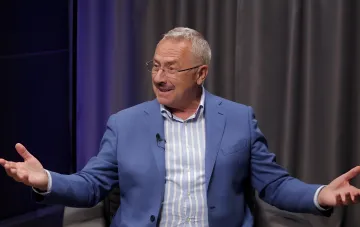
Former Ukrainian Prime Minister Arseniy Yatsenyuk, as part of RBC-Ukraine’s special project “Ukraine: 35 Years of Independence,” shared his recollections of the political confrontation with Petro Poroshenko during the Revolution of Dignity and the subsequent 2014 presidential elections. Speaking on air, the former prime minister assessed the fifth President of Ukraine’s communication and political-technological skills with his characteristic irony, acknowledging that Poroshenko had “truly unique” abilities in winning over voters at a critical moment for the country.
“One Cake” as a Symbol of Political Victory
The central element of Yatsenyuk’s remarks was a joke that has already become part of Ukrainian political folklore: “You have to have such remarkable abilities: bring just one cake to the Maidan — and for that everyone supported you and elected you president!” — said the former head of government, referring to the episode in which, against the backdrop of a starving Maidan, Poroshenko demonstrated care for the protesters, sharply boosting his image as the “savior of the nation.” According to Yatsenyuk, it was precisely this “phenomenal mastery in seizing the moment and building around himself the image of a savior” that allowed Poroshenko to secure a powerful vote of confidence without excessive effort. The former prime minister emphasized that this was not an underestimation of his opponent, but a statement of fact: in the conditions of the information and emotional overload of 2013–2014, even a minimal gesture, properly presented in the media space, could turn into a decisive electoral asset.
The Collapse of the Coalition and the “Combination” with Dissolving Parliament
A separate block of Yatsenyuk’s recollections was devoted to Poroshenko’s role in the collapse of the ruling coalition after the Revolution of Dignity. According to the former prime minister, the then head of state “pulled off a combination with the early dissolution of parliament,” which was later repeated in 2019. Yatsenyuk did not reveal all the details of the intra-political agreements, but pointed to the systemic nature of this mechanism: the formally legal procedure for dissolving the Verkhovna Rada was used as a tool to reset the political field in favor of the incumbent president. This thesis corresponds to the well-known practice of 2014, when Poroshenko signed a decree dissolving the Verkhovna Rada, leading to snap parliamentary elections in October 2014 and the subsequent consolidation of power around Petro Poroshenko’s Bloc.
Acknowledging a Mistake: the “Wall” Project and the Information War
The most resonant element of the interview was Yatsenyuk’s public acknowledgment of his own mistake regarding the “Wall” project — a system of engineering structures and barriers on the border with Russia. The former prime minister noted that he had “significantly underestimated the power of the information machine and the discreditation campaigns” that were launched against his government in connection with this project. In his words, the information support for the “Wall” was handled poorly: instead of being positioned as an element of national security, the project was turned by opponents into a symbol of a “dividing wall,” which damaged the cabinet’s reputation. This acknowledgment became one of the few cases in which Yatsenyuk, in the public sphere, took responsibility for a specific mistake rather than shifting the blame onto his entourage or external factors.
Historical Context: the 2014 Elections and Their Outcomes
The snap Presidential elections of Ukraine referred to in the interview took place on May 25, 2014. Petro Poroshenko won already in the first round, receiving 54.7% of the voters’ votes, which secured his mandate without the need for a second round. This result was made possible by a combination of several factors: the image of the “savior of the Maidan,” broad media support, as well as the split within Yanukovych’s pro-presidential bloc and the consolidation around Poroshenko of virtually all democratic and national forces. Yatsenyuk, who himself ran in the 2019 presidential elections, did not go into detail about the mechanics of his own campaign, limiting himself to the observation that the experience of 2014 showed: in times of crisis, electoral support is formed not so much by a program as by a candidate’s ability to “hook” the emotional demand of society in the very first days of the campaign.
Contradictory Data
No significant factual contradictions were found in the provided sources. Both outlets — RBC-Ukraine and novosti.ua — convey the content of Yatsenyuk’s speech in a unified manner, recording both the ironic form of delivery (“one cake”) and the substantive theses about Poroshenko’s political technologies, the collapse of the coalition, and the mistake with the “Wall” project. The differences concern only the style of the headlines and the volume of quotation, but not the factual base. The only nuance: in the RBC-Ukraine text the emphasis is placed on the humorous aspect of the statement, whereas novosti.ua underscores the context of the 2014 presidential race. Neither source contains an alternative version of events that would contradict the other.